
Excessive contact with Christians lately have placed me in a less-than-charitable frame of mind towards that religion, for which I must apologize to all my sincerely spiritual, open and loving, broad-minded and tolerant Christian friends. But you know the sort of Christian I'm referring to, for whom God is a narrow-minded bigot, imagined in their own image. Forgive me for this rant, my friends; it's on my mind and these words must be said.
That type of Christianity, unfortunately common, is a haven of the fearful, the cowardly, the small-minded. It is a place for those so crippled by their lives’ mistakes that they are willing to wear chains because it is the only way that they can walk. For some it is a place for those so terrified of descending once again into the hells from which they emerged that they accept any degree of tyranny over their lives rather than take the risks that go with freedom. So traumatized are they that their moral compass is broken beyond repair and they cannot tell right from wrong but like small children must be told by an external authority. This from those who claim to follow a teacher who confounded the Pharisees and rejected the blind authorities of his time and in general was a polar opposite from what they strive to be.
It’s such a sad thing that teachings of such promise have been so corrupted and ruined in service to the power-lust of men, who want the weak to be fearful so that they will more readily obey. It is perhaps the greatest loss in history that something which began so good became so evil. It almost makes me give credence to their idea of the devil, for they themselves bear witness to his reality. But perhaps this is a case of belief making itself real. They invoke the devil on a daily basis and so he becomes real in their minds, in their lives, in their thoughts, and in their deeds.
It is impossible, or nearly so, for a Christian to follow the teachings of Christ. So twisted has the purity of Jesus’ message become within the vise of Christian doctrine that his teachings can only be followed by someone outside the church, save by a miracle greater than raising the dead. For this reason, I now understand, Jesus came to me those years ago and told me to abandon Christianity. He was absolutely right, for it was a choice between abandoning that vile religion and abandoning him and God.
And yet many these are people who hunger for spiritual nourishment so much that they will even consume it poisoned. I cannot help but weep for them. If in my time among them I have helped a few to broaden their minds, then it’s been worth all the ugliness and not a total waste of time. That's how I have to think of it.
Wednesday, June 20, 2012

Sunday, June 10, 2012
Science Fiction versus Fantasy
So what's the difference between the two main branches of speculative fiction? It's not encompassed by the superficial details (ray guns, spaceships and robots versus wizards, elves, and dragons). There are conventions and expectations for each type of story, and not everyone who is attracted to one of them will be attracted to the other.
One convention is that in science fiction the science has to be consistent with real science even when it's way out there. A science fiction writer can put all sorts of things in a story that can't be proven or don't exist in real science at this time, including some very far-fetched speculation indeed, but he can't put anything in that can be proven wrong. That goes for everything from faster than light travel to alternative dimensions to psychic powers to practical probability physics to . . . well, you get the drift. None of that has to be real, but all of it has to be consistent with science to the extent that we can't say with certainty that it's NOT real. Fantasy, even if it's set in the real world (there's a sub-genre called "contemporary fantasy" that is; my own Star Mages trilogy falls into this category) can posit fantastic elements that have no foundation in science whatsoever and as long as the whole thing is logically consistent and lends itself to a fantasy-appropriate theme (see below), that's fine.
While this distinction is important, it's not the real, crucial, central difference between the two genres. That difference, in my opinion, lies in the set of themes appropriate to science fiction versus those appropriate to fantasy. These themes exist alongside of and in addition to the usual themes common to all literature (self-discovery, romantic love, all the personal struggles of life). A good science fiction or fantasy story will always deal with those universal themes in the course of character development, because that's true of all fiction regardless of genre. But in addition to that, a good science fiction story will always have a theme (or at least a subtext) that is political in nature, while a good fantasy story will always have a theme (or at least a subtext) that is religious in nature.
What do I mean by this? Well, science fiction, being set in the real world of a speculative future, must deal with the impact of changing technology on society and how future societies respond to those situations. For example, suppose that a science fiction story deals with the development of a perfect, unlimited, non-polluting energy source that, unfortunately, causes the deaths of a certain number of young children per year in an apparently random fashion. Will the society abandon this technology or make use of it? And suppose that a secret research project exists to discover just how the casualties are selected, so that they can be steered towards less "desirable" children (chosen by whatever -- race, class, intelligence, gender, predilection for social protest, religious belief)? There are moral issues here, of course, and the story may go into those in the course of character and plot development, but the main theme or subtext is always how society adapts to these changes, whether it does so in a positive or negative fashion.
Fantasy is quite different. A fantasy deals with such religious themes as a person's relationship with the gods or God or the cosmos, moral dilemmas, the expansion of consciousness, and the development of personal higher powers. For example, and somewhat in parallel to the hypothetical above, a fantasy story might deal with an item from an ancient tomb discovered by an occult-interested explorer, through which he contacts an ancient god who offers him staggering magical powers, but he must sacrifice a young child each year in order to gain these powers. The explorer must make this choice himself. Does he use the item? Destroy it? Leave it buried in the tomb? If he uses the power, how does he choose the children to be sacrificed? And, most important of all, what does this whole business do to his soul, to who he is as a person? There may be political issues involved in all this, but they are not major themes of the story.
It's been said (quite truly) that the Star Wars movies and novels are fantasy rather than science-fiction, despite their science-fiction trappings. The science in them is very bad, but the main reason they are fantasy is because they present a religious theme or themes (good versus evil, light versus darkness, personal choices, fall and redemption) and not primarily a political theme. Yes, the Galactic Republic is overthrown by the Empire and then restored at the end, but the real story is about what happens with the soul of Anakin Skywalker/Darth Vader, his fall to the Dark Side, and his redemption with the help of his son Luke.
Similarly, a fantasy story that deals primarily with the adjustment of a society to massive changes caused by an invasion of demons or a change in natural law is being written more like a science fiction story than a fantasy.
There are some examples that blend the two. For example, S.M. Stirling's wonderful "Change" series that begins with Dies the Fire has a lot in it about how human society changes and adjusts to the loss of all significant technology and the emergence of magic into the world, and yet it also has a lot about the personal journey, development, and moral evolution of the main characters. That's how it is with fiction and indeed with all art: there are no ironclad, absolute rules. But this one is going to be true most of the time.
One convention is that in science fiction the science has to be consistent with real science even when it's way out there. A science fiction writer can put all sorts of things in a story that can't be proven or don't exist in real science at this time, including some very far-fetched speculation indeed, but he can't put anything in that can be proven wrong. That goes for everything from faster than light travel to alternative dimensions to psychic powers to practical probability physics to . . . well, you get the drift. None of that has to be real, but all of it has to be consistent with science to the extent that we can't say with certainty that it's NOT real. Fantasy, even if it's set in the real world (there's a sub-genre called "contemporary fantasy" that is; my own Star Mages trilogy falls into this category) can posit fantastic elements that have no foundation in science whatsoever and as long as the whole thing is logically consistent and lends itself to a fantasy-appropriate theme (see below), that's fine.
While this distinction is important, it's not the real, crucial, central difference between the two genres. That difference, in my opinion, lies in the set of themes appropriate to science fiction versus those appropriate to fantasy. These themes exist alongside of and in addition to the usual themes common to all literature (self-discovery, romantic love, all the personal struggles of life). A good science fiction or fantasy story will always deal with those universal themes in the course of character development, because that's true of all fiction regardless of genre. But in addition to that, a good science fiction story will always have a theme (or at least a subtext) that is political in nature, while a good fantasy story will always have a theme (or at least a subtext) that is religious in nature.
What do I mean by this? Well, science fiction, being set in the real world of a speculative future, must deal with the impact of changing technology on society and how future societies respond to those situations. For example, suppose that a science fiction story deals with the development of a perfect, unlimited, non-polluting energy source that, unfortunately, causes the deaths of a certain number of young children per year in an apparently random fashion. Will the society abandon this technology or make use of it? And suppose that a secret research project exists to discover just how the casualties are selected, so that they can be steered towards less "desirable" children (chosen by whatever -- race, class, intelligence, gender, predilection for social protest, religious belief)? There are moral issues here, of course, and the story may go into those in the course of character and plot development, but the main theme or subtext is always how society adapts to these changes, whether it does so in a positive or negative fashion.
Fantasy is quite different. A fantasy deals with such religious themes as a person's relationship with the gods or God or the cosmos, moral dilemmas, the expansion of consciousness, and the development of personal higher powers. For example, and somewhat in parallel to the hypothetical above, a fantasy story might deal with an item from an ancient tomb discovered by an occult-interested explorer, through which he contacts an ancient god who offers him staggering magical powers, but he must sacrifice a young child each year in order to gain these powers. The explorer must make this choice himself. Does he use the item? Destroy it? Leave it buried in the tomb? If he uses the power, how does he choose the children to be sacrificed? And, most important of all, what does this whole business do to his soul, to who he is as a person? There may be political issues involved in all this, but they are not major themes of the story.
It's been said (quite truly) that the Star Wars movies and novels are fantasy rather than science-fiction, despite their science-fiction trappings. The science in them is very bad, but the main reason they are fantasy is because they present a religious theme or themes (good versus evil, light versus darkness, personal choices, fall and redemption) and not primarily a political theme. Yes, the Galactic Republic is overthrown by the Empire and then restored at the end, but the real story is about what happens with the soul of Anakin Skywalker/Darth Vader, his fall to the Dark Side, and his redemption with the help of his son Luke.
Similarly, a fantasy story that deals primarily with the adjustment of a society to massive changes caused by an invasion of demons or a change in natural law is being written more like a science fiction story than a fantasy.
There are some examples that blend the two. For example, S.M. Stirling's wonderful "Change" series that begins with Dies the Fire has a lot in it about how human society changes and adjusts to the loss of all significant technology and the emergence of magic into the world, and yet it also has a lot about the personal journey, development, and moral evolution of the main characters. That's how it is with fiction and indeed with all art: there are no ironclad, absolute rules. But this one is going to be true most of the time.
Thursday, May 24, 2012
The Best Advice for Writers: WRITE!
I had the interesting and somewhat humbling experience recently, as I cruise into the final stretch of creating a new novel and the first book of a new series, of going back and re-reading (or at least re-skimming) the first one I ever published. The occasion was the publication at Smashwords and Amazon of a one-volume e-book edition of the Star Mages trilogy, called (appropriately enough) The Star Mages.
(You can find The Star Mages at Amazon or at Smashwords at these links, by the way. Same price, $4.99, either source.)
So anyway, I have this nifty new all-in-one edition of the trilogy and so I took a look at it to see how it would appear in a Kindle, a Nook, or a Sony Reader (I have all three in the PC software versions). In doing so, I noticed that The Stairway to Nowhere, which is the first book of the trilogy, is not as well written as The Green Stone Tower, which is my new work in progress, or as the second and third books of the trilogy itself. There are places where Stairway comes off to me as a bit clumsy, not in its plot development or characterization but simply in the writing style, compared to what I can do now.
This was somewhat embarrassing but probably shouldn't be. Stairway isn't the first novel I ever wrote. (The first one I ever wrote is called A Tale of Metal, Mind and Feather and it's sitting on a hard drive unpublished. Maybe someday, with a LOT of revision.) But it is the first one I ever published, and quite honestly, it shows.
A lot of people have told me that some of the fantasy elements of The Star Mages remind them of Roger Zelazny's Amber series, with the multiple worlds and the polarity between two opposing forces. There's another resemblance in my opinion. The first book of Zelazny's series, Nine Princes in Amber, is quite clumsily written compared to all of the subsequent books. Nine Princes was not Zelazny's first published novel, but still suffered from a certain awkwardness of style that did not afflict the sequels to nearly the same degree.
All of this points up a piece of advice for writers that is really quite obvious but that doesn't get a whole lot of bandwidth. You can take classes in college. You can attend writers' groups and writers' workshops and writers' retreats. You can get advice from other writers, publishers, agents, and editors. All of that may be useful to a degree. But the best way to learn to write is to do it. There is simply no training, no education, no advice that carries the same learning potential as putting fingers to the keyboard and having the words appear on the screen and be saved to disk -- LOTS of words. Thousands and thousands of them.
Your first efforts are going to be crap. That's an unavoidable fact. If you have it in you to do this, eventually, in the process of writing a whole lot of crap, you should reach a point where you begin to write non-crap. And then, hopefully, something that's actually pretty decent. And eventually, if you keep at it -- something good. Or really good. I'm still trying to get to that point, but I like to think I've hit the non-crap point and maybe even the pretty decent point.
But you have to write the crap first. There are no shortcuts.
(You can find The Star Mages at Amazon or at Smashwords at these links, by the way. Same price, $4.99, either source.)
So anyway, I have this nifty new all-in-one edition of the trilogy and so I took a look at it to see how it would appear in a Kindle, a Nook, or a Sony Reader (I have all three in the PC software versions). In doing so, I noticed that The Stairway to Nowhere, which is the first book of the trilogy, is not as well written as The Green Stone Tower, which is my new work in progress, or as the second and third books of the trilogy itself. There are places where Stairway comes off to me as a bit clumsy, not in its plot development or characterization but simply in the writing style, compared to what I can do now.
This was somewhat embarrassing but probably shouldn't be. Stairway isn't the first novel I ever wrote. (The first one I ever wrote is called A Tale of Metal, Mind and Feather and it's sitting on a hard drive unpublished. Maybe someday, with a LOT of revision.) But it is the first one I ever published, and quite honestly, it shows.
A lot of people have told me that some of the fantasy elements of The Star Mages remind them of Roger Zelazny's Amber series, with the multiple worlds and the polarity between two opposing forces. There's another resemblance in my opinion. The first book of Zelazny's series, Nine Princes in Amber, is quite clumsily written compared to all of the subsequent books. Nine Princes was not Zelazny's first published novel, but still suffered from a certain awkwardness of style that did not afflict the sequels to nearly the same degree.
All of this points up a piece of advice for writers that is really quite obvious but that doesn't get a whole lot of bandwidth. You can take classes in college. You can attend writers' groups and writers' workshops and writers' retreats. You can get advice from other writers, publishers, agents, and editors. All of that may be useful to a degree. But the best way to learn to write is to do it. There is simply no training, no education, no advice that carries the same learning potential as putting fingers to the keyboard and having the words appear on the screen and be saved to disk -- LOTS of words. Thousands and thousands of them.
Your first efforts are going to be crap. That's an unavoidable fact. If you have it in you to do this, eventually, in the process of writing a whole lot of crap, you should reach a point where you begin to write non-crap. And then, hopefully, something that's actually pretty decent. And eventually, if you keep at it -- something good. Or really good. I'm still trying to get to that point, but I like to think I've hit the non-crap point and maybe even the pretty decent point.
But you have to write the crap first. There are no shortcuts.
Tuesday, May 8, 2012
Libertarianism and the Wilderness
It occurred to me recently that the best metaphor for describing the libertarian conception of liberty, the rights of the individual, and all of the thinking underlying libertarian positions on both social and economic issues is the concept of the wilderness or the frontier.
This concept is a defining archetype of American history, and libertarianism is a quintessentially American political philosophy (which is not to say that most Americans believe in it -- not the same thing), so it should not be surprising that the two should go together. For much of American history up until the late 19th century, the perceived reality of life in the United States included a lot of land that belonged to nobody. (Well -- nobody except Indians. Which in the thinking of Americans at that time pretty much meant nobody. The Indians might object if you tried to claim that unclaimed land, sometimes violently, but that was just part of the risk.) There was "back east," where most of the land was settled and belonged to someone, and then there was "out west," where most of the land was unclaimed. You built a homestead, there were somewhat fuzzy boundary lines around what was yours, then there was wilderness, unclaimed land, and then you came to someone else's homestead with its own fuzzy boundary lines. Cross over into someone else's land and try to make off with their cattle or sheep or pigs or whatever, and you were committing a crime, but you could leave your own property, wander into the wilderness that nobody had title to, and be free as a bird, able to make use of whatever the Indians wouldn't shoot you for using.
Now think of land ownership as a metaphor for rights in general. The old saying, "Your right to swing your fist ends where my nose begins," is agreed to by just about everyone, and that includes libertarians. But in the libertarian conception, we're not very close together, and so the chance of my swinging fist contacting your nose is pretty slim. They agree that it's possible and that's what the law is for (libertarians by definition aren't anarchists), but you have to go pretty seriously out of your way to interfere with someone else's rights. Unless you're the government. The government, in the libertarian conception, exists to protect people's rights, but in reality the government is the main thing that tramples on people's rights and that describes most of its activity except on the rare occasions when someone does in fact go out of his way to be a pain, such as a burglar breaking into your house.
The libertarian conception of rights can be depicted visually like this:
 Rights, in this way of thinking, are like homesteads in the wilderness. There's your rights and my rights, and a lot of open space in between that represents nobody's rights. You can do pretty much whatever you want, as long as you don't cross over into that little space that defines "my rights" or "his rights."
Contrasting the archetype of the wilderness is what was happening "back east," or in Europe or other civilized places. (Or sissified places, depending on your point of view.) In that conception, there was no wilderness. Everything belonged to someone or other, so as soon as you go off your own land you are either in public space (which has its own rules of behavior) or you are on someone else's territory and quite possibly trespassing. That lends itself to a conception of rights, too, in which any action you take bumps into someone else, and a ruling is required (either legal or informal) as to whether you have a right to do that in the particular case. Here's a visual conception of that:
 Here, if you step outside your own rights you are automatically infringing on the rights of someone else. There is no open, unclaimed territory. Rights become a matter of dividing up freedom of action (or property, as the case may be). If the right to do something isn't mine, that means it's yours, or his, or hers, or theirs, or anyway it's somebody's.
One of the purposes of government is to mediate disputes among citizens. That's why we have civil law; in severe cases, it's also why we have criminal law. Obviously, a lot more government will be needed when the reality of rights is similar to the second illustration than it will if it resembles the first.
This concept is a defining archetype of American history, and libertarianism is a quintessentially American political philosophy (which is not to say that most Americans believe in it -- not the same thing), so it should not be surprising that the two should go together. For much of American history up until the late 19th century, the perceived reality of life in the United States included a lot of land that belonged to nobody. (Well -- nobody except Indians. Which in the thinking of Americans at that time pretty much meant nobody. The Indians might object if you tried to claim that unclaimed land, sometimes violently, but that was just part of the risk.) There was "back east," where most of the land was settled and belonged to someone, and then there was "out west," where most of the land was unclaimed. You built a homestead, there were somewhat fuzzy boundary lines around what was yours, then there was wilderness, unclaimed land, and then you came to someone else's homestead with its own fuzzy boundary lines. Cross over into someone else's land and try to make off with their cattle or sheep or pigs or whatever, and you were committing a crime, but you could leave your own property, wander into the wilderness that nobody had title to, and be free as a bird, able to make use of whatever the Indians wouldn't shoot you for using.
Now think of land ownership as a metaphor for rights in general. The old saying, "Your right to swing your fist ends where my nose begins," is agreed to by just about everyone, and that includes libertarians. But in the libertarian conception, we're not very close together, and so the chance of my swinging fist contacting your nose is pretty slim. They agree that it's possible and that's what the law is for (libertarians by definition aren't anarchists), but you have to go pretty seriously out of your way to interfere with someone else's rights. Unless you're the government. The government, in the libertarian conception, exists to protect people's rights, but in reality the government is the main thing that tramples on people's rights and that describes most of its activity except on the rare occasions when someone does in fact go out of his way to be a pain, such as a burglar breaking into your house.
The libertarian conception of rights can be depicted visually like this:
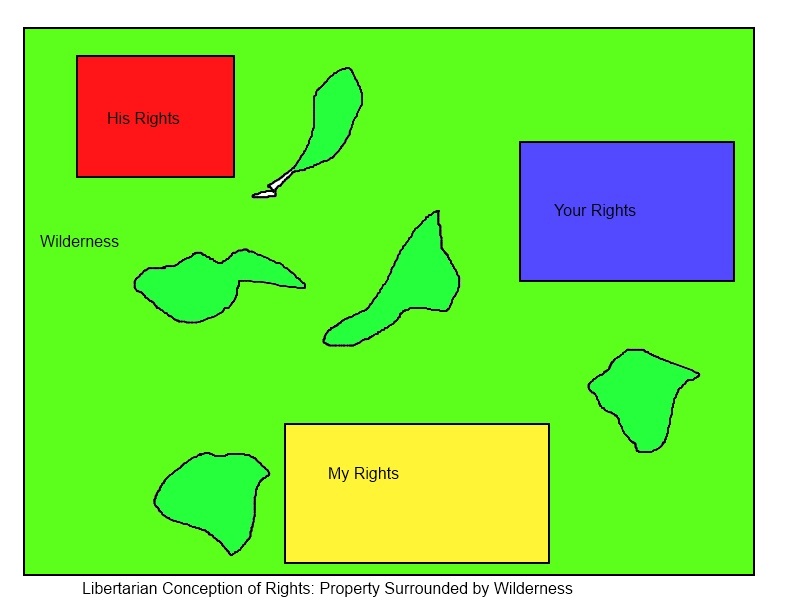
Contrasting the archetype of the wilderness is what was happening "back east," or in Europe or other civilized places. (Or sissified places, depending on your point of view.) In that conception, there was no wilderness. Everything belonged to someone or other, so as soon as you go off your own land you are either in public space (which has its own rules of behavior) or you are on someone else's territory and quite possibly trespassing. That lends itself to a conception of rights, too, in which any action you take bumps into someone else, and a ruling is required (either legal or informal) as to whether you have a right to do that in the particular case. Here's a visual conception of that:

One of the purposes of government is to mediate disputes among citizens. That's why we have civil law; in severe cases, it's also why we have criminal law. Obviously, a lot more government will be needed when the reality of rights is similar to the second illustration than it will if it resembles the first.
Thursday, April 19, 2012
Revelation or Discovery? Two Models of Spiritual Truth
I don't much enjoy discussing religious matters with adherents of doctrinaire faiths such as the majority of Christians and Muslims (there are exceptions in both cases, of course), except when the mischievous imp in my personality takes over and prompts me to yank their chains. We come at spirituality, the doctrinaire and I, from completely different epistemological assumptions. It is therefor extremely difficult to find common ground or any basis for discussion. But examining these two diametrically opposed ways of approaching the truth can perhaps be useful and instructive.
My own approach is one of discovery. I hold the sacred reality which is variously (and always metaphorically) termed God, the Gods, or other words for principles underlying the reality that we sense and in which we live, to be something that, while never possible for the human mind to encompass in its totality, we can discover. It lies at the bottom of our own being and at the core of the world's essence. The process of discovering it is also a process both of self-discovery and of self-transformation, in which the mind grows wider, deeper, more perceptive, and better able to embrace and understand. The discovery of the sacred is a stretching of the mind. It's the only thing that allows sacred reality to be comprehended at all, in my view.
Since sacred reality is there to be discovered, everyone who discovers it finds the same reality, even though the process of discovery varies. As an old Japanese proverb has it, there are many paths up the mountain, but the view of the moon from the top is the same. This is why mystics of all sorts, no matter what their starting-point religion, always end up saying very similar things and recognizing the oneness of all faiths.
I view spirituality as like a wheel, in which sacred reality is at the hub, while normal consciousness resides out on the rim. Religions are like the spokes of the wheel, bridging the rim and the hub. Each spoke is most distinct from the other spokes at the rim, at the shallow end of perception, and approaches common ground the closer it approaches the hub of the wheel, where God is.
All of this makes perfect sense to me, but it rests on the epistemological assumption that discovery is the way to know sacred reality. The doctrinaire make a different assumption: that sacred reality cannot be discovered, but can be known only by revelation.
Revelation is not a human act but a divine one. It involves sacred reality revealing itself to a prophet such as Moses, Jesus, or Mohammed, who communicates this reality to others in words and symbols. The more thoughtful among the doctrinaire recognize, as I do, that ultimately the sacred reality is unknowable, but they disagree with me that it can even be approached through human effort. The inadequacy of revelation for complete knowledge is acknowledged, but of course the same is true for discovery; when it comes to sacred reality there is no such thing as "complete knowledge."
An epistemological divide is essentially unbridgeable, because neither side acknowledges the proofs of the other as valid. Each side has its own way of knowing, and hence its own way of proving. There are perhaps some observations I can make about problems with the revelation mode of knowing, but when people begin with the assumption that a certain body of written word is revealed truth, there is not much more to be said, is there? Still, the effort should be made, if nothing else to clarify my own thoughts.
One problem with revelation is correctly identifying genuine revelation and distinguishing it from pretenders. Consider the Bible, for example. This is a collection of short books in three different languages (Hebrew, Biblical Aramaic, and ancient Greek) by many different authors. At some time in the dim past, Jewish authorities have identified the five books of the Torah (Genesis, Exodus, Leviticus, Numbers, and Deuteronomy) as sacred, with lesser degrees of sacredness applied to the Biblical historical accounts, the five books of poetry and philosophy (Job, Psalms, Proverbs, Ecclesiastes, and the Song of Songs), and the books of the major and minor Prophets. The Imperial Church at its founding in 325 or shortly thereafter adopted all of these books from the Jews without distinguishing among them in Jewish fashion, simply saying that they were all equally sacred, and added a selection of Christian writings chosen from among the many in circulation at the time: four Gospels, one history of the very early Church, a number of letters of instruction from Paul of Tarsus and several of the Apostles to various Christians, and one (very weird) book of prophecy. In each case, we have the testimony of various authority figures, backed by the government either of the Kings of Judea or of the Roman Empire, that these writings are to be taken as sacred.
So the first question is simply this: Why should we believe them? On what basis should we conclude that politicians (as we must regard these men) are proper judges of spiritual validity? Today's politicians certainly don't inspire a lot of confidence along those lines. I mean, would you accept the word of President Obama that a particular text revealed the truth of the Gods? Not I, and I say that as someone who voted for him. I voted for him for President of the United States, not for Supreme Spiritual Leader and Prophet. Nor would I consider him an appropriate choice for the latter office.
If we cannot trust the enlightenment of those who have chosen the sacred books, how can we take their word for it that the books are sacred? How can we be sure that they chose correctly among the various possibilities?
Another problem arises when we examine the texts of alleged sacred books themselves, and I am not referring here to contradictions or clearly non-factual statements (those are open to interpretation or to the recognition that sacred writing is neither science nor history). I am referring to cases in which the alleged revelatory text seems to itself endorse a discovery approach. Many of the parables of Jesus seem to point that direction, as does his encouragement to the Apostles to develop their own relationship with God, to recognize the presence of God within them, and to draw upon this presence through faith to accomplish miracles similar to (and even greater than) what Jesus himself is said to have done. Jesus himself seems to have endorsed a discovery method for identifying sacred truth, so isn't the allegedly sacred text itself contradicting, here and in other places, the claims of those who swear by it?
Finally, let's recognize that all sacred writings had human authors. Each human author, if the claims of the revelationists are correct, had a direct relationship with and/or experience of sacred reality, from which he derived the written word. As this sort of relationship and experience is what discovery advocates like myself are talking about, revelation draws upon the same source -- but at second hand rather than directly. If discovery cannot suffice to gain the truth, then neither can revelation, because revelation depends on discovery ultimately.
All of these arguments seem good to me, but I know very well that they will not persuade the doctrinaire, because the application of logic and evidence are themselves inappropriate to a revelation-based epistemic model, except insofar as logic reasons from the premise that the text is sacred, and evidence draws upon the words of the sacred writings themselves, without questioning their validity (only their interpretation). It is in the end a pointless exercise, except insofar as it helps our own thoughts to be clear.
My own approach is one of discovery. I hold the sacred reality which is variously (and always metaphorically) termed God, the Gods, or other words for principles underlying the reality that we sense and in which we live, to be something that, while never possible for the human mind to encompass in its totality, we can discover. It lies at the bottom of our own being and at the core of the world's essence. The process of discovering it is also a process both of self-discovery and of self-transformation, in which the mind grows wider, deeper, more perceptive, and better able to embrace and understand. The discovery of the sacred is a stretching of the mind. It's the only thing that allows sacred reality to be comprehended at all, in my view.
Since sacred reality is there to be discovered, everyone who discovers it finds the same reality, even though the process of discovery varies. As an old Japanese proverb has it, there are many paths up the mountain, but the view of the moon from the top is the same. This is why mystics of all sorts, no matter what their starting-point religion, always end up saying very similar things and recognizing the oneness of all faiths.
I view spirituality as like a wheel, in which sacred reality is at the hub, while normal consciousness resides out on the rim. Religions are like the spokes of the wheel, bridging the rim and the hub. Each spoke is most distinct from the other spokes at the rim, at the shallow end of perception, and approaches common ground the closer it approaches the hub of the wheel, where God is.
All of this makes perfect sense to me, but it rests on the epistemological assumption that discovery is the way to know sacred reality. The doctrinaire make a different assumption: that sacred reality cannot be discovered, but can be known only by revelation.
Revelation is not a human act but a divine one. It involves sacred reality revealing itself to a prophet such as Moses, Jesus, or Mohammed, who communicates this reality to others in words and symbols. The more thoughtful among the doctrinaire recognize, as I do, that ultimately the sacred reality is unknowable, but they disagree with me that it can even be approached through human effort. The inadequacy of revelation for complete knowledge is acknowledged, but of course the same is true for discovery; when it comes to sacred reality there is no such thing as "complete knowledge."
An epistemological divide is essentially unbridgeable, because neither side acknowledges the proofs of the other as valid. Each side has its own way of knowing, and hence its own way of proving. There are perhaps some observations I can make about problems with the revelation mode of knowing, but when people begin with the assumption that a certain body of written word is revealed truth, there is not much more to be said, is there? Still, the effort should be made, if nothing else to clarify my own thoughts.
One problem with revelation is correctly identifying genuine revelation and distinguishing it from pretenders. Consider the Bible, for example. This is a collection of short books in three different languages (Hebrew, Biblical Aramaic, and ancient Greek) by many different authors. At some time in the dim past, Jewish authorities have identified the five books of the Torah (Genesis, Exodus, Leviticus, Numbers, and Deuteronomy) as sacred, with lesser degrees of sacredness applied to the Biblical historical accounts, the five books of poetry and philosophy (Job, Psalms, Proverbs, Ecclesiastes, and the Song of Songs), and the books of the major and minor Prophets. The Imperial Church at its founding in 325 or shortly thereafter adopted all of these books from the Jews without distinguishing among them in Jewish fashion, simply saying that they were all equally sacred, and added a selection of Christian writings chosen from among the many in circulation at the time: four Gospels, one history of the very early Church, a number of letters of instruction from Paul of Tarsus and several of the Apostles to various Christians, and one (very weird) book of prophecy. In each case, we have the testimony of various authority figures, backed by the government either of the Kings of Judea or of the Roman Empire, that these writings are to be taken as sacred.
So the first question is simply this: Why should we believe them? On what basis should we conclude that politicians (as we must regard these men) are proper judges of spiritual validity? Today's politicians certainly don't inspire a lot of confidence along those lines. I mean, would you accept the word of President Obama that a particular text revealed the truth of the Gods? Not I, and I say that as someone who voted for him. I voted for him for President of the United States, not for Supreme Spiritual Leader and Prophet. Nor would I consider him an appropriate choice for the latter office.
If we cannot trust the enlightenment of those who have chosen the sacred books, how can we take their word for it that the books are sacred? How can we be sure that they chose correctly among the various possibilities?
Another problem arises when we examine the texts of alleged sacred books themselves, and I am not referring here to contradictions or clearly non-factual statements (those are open to interpretation or to the recognition that sacred writing is neither science nor history). I am referring to cases in which the alleged revelatory text seems to itself endorse a discovery approach. Many of the parables of Jesus seem to point that direction, as does his encouragement to the Apostles to develop their own relationship with God, to recognize the presence of God within them, and to draw upon this presence through faith to accomplish miracles similar to (and even greater than) what Jesus himself is said to have done. Jesus himself seems to have endorsed a discovery method for identifying sacred truth, so isn't the allegedly sacred text itself contradicting, here and in other places, the claims of those who swear by it?
Finally, let's recognize that all sacred writings had human authors. Each human author, if the claims of the revelationists are correct, had a direct relationship with and/or experience of sacred reality, from which he derived the written word. As this sort of relationship and experience is what discovery advocates like myself are talking about, revelation draws upon the same source -- but at second hand rather than directly. If discovery cannot suffice to gain the truth, then neither can revelation, because revelation depends on discovery ultimately.
All of these arguments seem good to me, but I know very well that they will not persuade the doctrinaire, because the application of logic and evidence are themselves inappropriate to a revelation-based epistemic model, except insofar as logic reasons from the premise that the text is sacred, and evidence draws upon the words of the sacred writings themselves, without questioning their validity (only their interpretation). It is in the end a pointless exercise, except insofar as it helps our own thoughts to be clear.
Monday, April 16, 2012
The Devil and Dualism: or, Having One's Cake and Eating It, Too
Emerging from some discussions with evangelical Christians and Catholics on another forum regarding the subject of Hell and the Devil has prompted some thoughts a bit too complex for that forum, but worth pursuing. So I will pursue them here.
The Devil/Hell complex of ideas in traditional Christianity is similar to -- yet different from in a fundamental way -- the older Zoroastrian concept of a division of the universe into good and evil principles. Ahura Mazda and Ahriman were thought of as equal principles, equal in power, knowledge, and wisdom, engaged in a conflict throughout the ages. In this way, Zoroaster resolved the philosophical conundrum of how God can be both all good and all powerful, given the existence of evil. His perfectly logical conclusion was to surrender half the goal: God (Ahura Mazda) is all good, but he is not all powerful. He has an opponent who is just as strong and completely independent of his will, and from this opponent come all wickedness and misfortune.
Christians resolve the same conundrum somewhat more problematically by the device of free will, stating that God, although all powerful, cannot do what is logically self-contradictory; he cannot at the same time make human beings free and remove their capacity for sin. This works as an explanation for human evil, but not for misfortune or suffering that comes from a source outside humanity. Most especially, it does not work for the Christian idea of Hell.
The Devil, in Christian theology, acts by divine permission. He can do nothing that God does not allow. Hence, everything done by the Devil is, at one remove, an act of God, insofar as people (including God) are responsible for their sins of omission as well as of commission. Hell is the work of God; God sends people to suffer in perpetuity. Sin may be an inevitable outcome of free will. Sin's punishment, certainly that particular outrageous punishment, is not. And so through the theological device of Hell, Christians re-introduce the philosophical conundrum that Zoroaster resolved. The God of Christians, if he indeed created Hell and sentences sinners (or, even worse, mere unbelievers) to that immeasurably draconian fate, is not all good. Or, if he did not, if Hell is the work of the Devil, acting independently of God and in ways God cannot prevent, then God is not all powerful. He has become more like Ahura Mazda, only a co-creator of the world along with a principle of evil that is just as strong.
Some Christian theological ideas do paint God as not being all powerful. One idea is that God cannot touch or be in contact with sin. Thus, it is said, God cannot embrace or accept sinners into his presence in Heaven, unless their sins are covered by the blood of Christ. Leaving aside the savagely sanguine quality of that image for the moment, here we are faced with a limitation on the power of God. There is something that he cannot do, which is not logically self-contradictory. God is not all powerful. And yet, faced with this question in words, Christians would deny it. Yet if it is not so -- if God is all powerful -- then either God is not all good (indeed, is a monstrous tyrant worse than any mere human tyrant who has ever lived), or there is no Hell.
The question must be asked why Christians devised the idea of Hell in the first place. It is a strictly Christian idea, rather than one derived from the three sources of ancient Roman Christianity (Judaism, the teachings of Jesus, and Greco-Roman paganism). Judaism has nothing like it, indeed no concept of an afterlife at all. The teachings of Jesus as reported in the Gospels contain some images and metaphors that could slant that direction, but no clear statement that the soul of the sinner or unbeliever is punished perpetually after death (and there are much better and more likely interpretations of his metaphors). Greco-Roman paganism contained some limited ideas of divine punishment after death, but only in extraordinary cases of people who had severely offended the Gods, and even they (Sisyphus, Tantalus) received punishments that came nowhere near the perpetual torture inflicted on the mildest of offenders in Christian theology. In fact, nowhere even in the New Testament is this idea clearly set forth. So why did Christians develop and implement it?
The most likely answer is that, like the belief in Christian exclusive possession of the truth itself, Hell was a device for enforcing the power and authority of the Imperial Church, or of the proto-authorities that pre-existed it and emerged to dominance by means of it. As the power of the Imperial Church and of the Roman Catholic and Eastern Orthodox Churches into which it split fades, as separation of church and state becomes the norm worldwide, more and more Christians today seem to be abandoning the idea of Hell, or at least modifying it so that it is less offensive to civilized concepts of morality.
Continuing along these lines of thought, what of the very idea of dividing the world into principles set by moral judgment? Granted that for humans, judging the value, the goodness or badness, of events, behavior, and each other is part of who we are and something fundamental to our societies, is it really right to say that it is fundamental to the cosmos itself? Is there any evidence that the universe is either good or evil, in terms that are meaningful to human moral judgments? And if it is not, does it make any sense to apply terms like that to personifications of the universe such as God or the Gods? What of that other pole of the philosophical conundrum? Could it be that God is indeed all powerful, but is not all good? This is the solution that Ahura Mazda rejected and that most religious people of any religion do, too. But perhaps it is the most sensible conclusion.
The idea of God as not good but beyond good, the idea that human judgments simply have no meaning when applied to God, has a beautifully poetic expression in the Book of Job. "Will we receive good from God but not also receive bad?" (Job 2:10). In the discussion between Job and his friends, much time is given to examining the mysterious work of God in visiting suffering on the good as well as the evil, or good fortune on the wicked as well as the just. By his works, God cannot be judged either good or evil. In the end, after much interesting discussion among the friends, God emerges from a whirlwind and declares himself a mystery not to be judged by the standards of men. "Where were you when I laid the earth’s foundations?
Tell me if you know. Who set its measurements? Surely you know. Who stretched a measuring tape on it? On what were its footings sunk; who laid its cornerstone, while the morning stars sang in unison and all the divine beings shouted?"
A child, in the custody and protection of its parents, has a simplistic idea of morality as coming from its parents, from outside itself, but in maturity takes responsibility for its own judgments. Similarly the idea of morality as laid down by the Gods is one for an immature civilization; but it is not nature, not the Gods, and not God who sets out standards of good and evil. We do that ourselves, and rightly so, by our own authority, according to what seems good to us. As our civilization gropes its stumbling way towards maturity, perhaps we have reached a point now when we may assume that responsibility, and see good and evil as a product of human judgment rather than of the Gods.
The Gods, like nature, are neither good nor evil. The Gods, like nature, are wild.
The Devil/Hell complex of ideas in traditional Christianity is similar to -- yet different from in a fundamental way -- the older Zoroastrian concept of a division of the universe into good and evil principles. Ahura Mazda and Ahriman were thought of as equal principles, equal in power, knowledge, and wisdom, engaged in a conflict throughout the ages. In this way, Zoroaster resolved the philosophical conundrum of how God can be both all good and all powerful, given the existence of evil. His perfectly logical conclusion was to surrender half the goal: God (Ahura Mazda) is all good, but he is not all powerful. He has an opponent who is just as strong and completely independent of his will, and from this opponent come all wickedness and misfortune.
Christians resolve the same conundrum somewhat more problematically by the device of free will, stating that God, although all powerful, cannot do what is logically self-contradictory; he cannot at the same time make human beings free and remove their capacity for sin. This works as an explanation for human evil, but not for misfortune or suffering that comes from a source outside humanity. Most especially, it does not work for the Christian idea of Hell.
The Devil, in Christian theology, acts by divine permission. He can do nothing that God does not allow. Hence, everything done by the Devil is, at one remove, an act of God, insofar as people (including God) are responsible for their sins of omission as well as of commission. Hell is the work of God; God sends people to suffer in perpetuity. Sin may be an inevitable outcome of free will. Sin's punishment, certainly that particular outrageous punishment, is not. And so through the theological device of Hell, Christians re-introduce the philosophical conundrum that Zoroaster resolved. The God of Christians, if he indeed created Hell and sentences sinners (or, even worse, mere unbelievers) to that immeasurably draconian fate, is not all good. Or, if he did not, if Hell is the work of the Devil, acting independently of God and in ways God cannot prevent, then God is not all powerful. He has become more like Ahura Mazda, only a co-creator of the world along with a principle of evil that is just as strong.
Some Christian theological ideas do paint God as not being all powerful. One idea is that God cannot touch or be in contact with sin. Thus, it is said, God cannot embrace or accept sinners into his presence in Heaven, unless their sins are covered by the blood of Christ. Leaving aside the savagely sanguine quality of that image for the moment, here we are faced with a limitation on the power of God. There is something that he cannot do, which is not logically self-contradictory. God is not all powerful. And yet, faced with this question in words, Christians would deny it. Yet if it is not so -- if God is all powerful -- then either God is not all good (indeed, is a monstrous tyrant worse than any mere human tyrant who has ever lived), or there is no Hell.
The question must be asked why Christians devised the idea of Hell in the first place. It is a strictly Christian idea, rather than one derived from the three sources of ancient Roman Christianity (Judaism, the teachings of Jesus, and Greco-Roman paganism). Judaism has nothing like it, indeed no concept of an afterlife at all. The teachings of Jesus as reported in the Gospels contain some images and metaphors that could slant that direction, but no clear statement that the soul of the sinner or unbeliever is punished perpetually after death (and there are much better and more likely interpretations of his metaphors). Greco-Roman paganism contained some limited ideas of divine punishment after death, but only in extraordinary cases of people who had severely offended the Gods, and even they (Sisyphus, Tantalus) received punishments that came nowhere near the perpetual torture inflicted on the mildest of offenders in Christian theology. In fact, nowhere even in the New Testament is this idea clearly set forth. So why did Christians develop and implement it?
The most likely answer is that, like the belief in Christian exclusive possession of the truth itself, Hell was a device for enforcing the power and authority of the Imperial Church, or of the proto-authorities that pre-existed it and emerged to dominance by means of it. As the power of the Imperial Church and of the Roman Catholic and Eastern Orthodox Churches into which it split fades, as separation of church and state becomes the norm worldwide, more and more Christians today seem to be abandoning the idea of Hell, or at least modifying it so that it is less offensive to civilized concepts of morality.
Continuing along these lines of thought, what of the very idea of dividing the world into principles set by moral judgment? Granted that for humans, judging the value, the goodness or badness, of events, behavior, and each other is part of who we are and something fundamental to our societies, is it really right to say that it is fundamental to the cosmos itself? Is there any evidence that the universe is either good or evil, in terms that are meaningful to human moral judgments? And if it is not, does it make any sense to apply terms like that to personifications of the universe such as God or the Gods? What of that other pole of the philosophical conundrum? Could it be that God is indeed all powerful, but is not all good? This is the solution that Ahura Mazda rejected and that most religious people of any religion do, too. But perhaps it is the most sensible conclusion.
The idea of God as not good but beyond good, the idea that human judgments simply have no meaning when applied to God, has a beautifully poetic expression in the Book of Job. "Will we receive good from God but not also receive bad?" (Job 2:10). In the discussion between Job and his friends, much time is given to examining the mysterious work of God in visiting suffering on the good as well as the evil, or good fortune on the wicked as well as the just. By his works, God cannot be judged either good or evil. In the end, after much interesting discussion among the friends, God emerges from a whirlwind and declares himself a mystery not to be judged by the standards of men. "Where were you when I laid the earth’s foundations?
Tell me if you know. Who set its measurements? Surely you know. Who stretched a measuring tape on it? On what were its footings sunk; who laid its cornerstone, while the morning stars sang in unison and all the divine beings shouted?"
A child, in the custody and protection of its parents, has a simplistic idea of morality as coming from its parents, from outside itself, but in maturity takes responsibility for its own judgments. Similarly the idea of morality as laid down by the Gods is one for an immature civilization; but it is not nature, not the Gods, and not God who sets out standards of good and evil. We do that ourselves, and rightly so, by our own authority, according to what seems good to us. As our civilization gropes its stumbling way towards maturity, perhaps we have reached a point now when we may assume that responsibility, and see good and evil as a product of human judgment rather than of the Gods.
The Gods, like nature, are neither good nor evil. The Gods, like nature, are wild.
Monday, February 27, 2012
Why Capitalism is Doomed
Heh -- I love a nice attention-grabbing title. :)
On this occasion, though, it's meant literally. Capitalism is doomed, and what's dooming it is the advance of technology.
Capitalism is an economic system characterized by private ownership of the means of production and the defining of ownership of goods by who owns the capital that is used to produce the goods. That's a fancy and technical way of saying that it's a system designed to facilitate rich people getting richer. As with any economic system, capitalism rests upon government action that sets the rules of the game.
Now, in theory, we have a democracy in this country, so government action must pass public muster. We must therefore recognize that capitalism exists on public sufferance, and at such time as that sufferance is removed, it will cease to exist and be replaced by a different economic system.
Which bring up another question: why was capitalism allowed to exist in the first place? I mean, if you were to go to the average working stiff on the street and ask, "Would you be willing to pay taxes, fight wars, and work like a slave your whole life so a few fat cats can get even richer?" the answer would surely be "Hell, no!" Yet people did support the system for a long time, and there was in fact a good, self-interested reason to do so.
Capitalism depends on a social compact, as does government itself. It's an unwritten compact impossible to enforce legally, but well understood by the people. The agreement went something like this. We allow a few rich people to control the nation's wealth, and to channel a large share of that wealth to themselves, and in return they will arrange things so that just about everyone enjoys rising standards of living throughout their lives and from generation to generation.
For a long time, it worked. The compact was kept, the promise fulfilled. Even during the Gilded Age or the Roaring Twenties, the heydey of unbridled laissez-faire capitalism, the era of trusts and monopolies and robber barons, high demand for labor meant that wages rose steadily. The system seemed to break down in the Great Depression, but it proved fixable by some moderate reforms: government regulations on business and encouragement of labor unions. The golden age of capitalism in America was in the decades after World War II, when high demand for labor coupled with strong unions kept wages high and climbing along with productivity. The rich got richer. So did the non-rich. Rising standards of living for almost everyone kept the people happy with the bargain. Capitalism, with proper controls, worked.
But in order to keep that compact, there is one essential factor. The production of wealth MUST require labor. It must be necessary for capitalists to share at least a nonzero amount of the wealth produced in order to produce the wealth at all. Given that, a labor-friendly government and strong unions can leverage this requirement into sharing of the wealth on an almost equitable scale.
Today, increasingly, we are divorcing the production of wealth from the work that used to be required to produce it. It's increasingly possible now to produce wealth without labor. We are well past the era of dumb machines replacing grunt work; today, sophisticated computer technology is replacing human labor for everything from typing to customer service to movie extras. (I've even seen software that can write articles. I have my worried eye on that, believe me.)
Technology can replace most of the work of lawyers other than actual appearance in court. Technology can replace much of a doctor's work apart from a bedside manner. Technology can replace all the craft of an artist short of true creative genius -- and I'm not even sure about that! We still have work in this economy: really high-paying professional work requiring advanced education, and really low-paying service work requiring nothing but a warm body and work ethic. But the middle-ground, decent-paying work that used to comprise the majority of the labor force is rapidly disappearing. We are fast approaching the time when the only jobs left are those too complicated to be worth the effort of automating, and those too low-paying to be worth the expense of doing so.
(A side note on outsourcing. As a practical matter, outsourcing is certainly a problem, but only because ridiculously cheap labor is available, so that it is more cost-effective to employ that labor than to automate the work. If for some reason the source of cheap labor abroad were to evaporate and the jobs had to be brought home, they would not stay here long, but would be replaced by machines as soon as practicable.)
Under these conditions, capitalism fails of its promise. The social compact on which its existence depends is broken. It no longer provides rising standards of living for most people. And that means the sufferance of the people is being withdrawn. It's already happening.
There is no way to restore the demand for labor that allowed its success in the past. Automated production is superior to labor-dependent production and the former will drive the latter out of business, so even if we were to adopt the most labor-friendly legislation imaginable, the problem would remain intractable. As long as we depend on wages paid for work to distribute wealth -- and capitalism entails that dependence -- we have lost forever a system that can promise rising standards of living for most people throughout their lives and from generation to generation. Instead, for most people, as long as capitalism remains in place, things will only get worse.
And that is unacceptable, and will not be accepted.
And that is why capitalism is doomed.
On this occasion, though, it's meant literally. Capitalism is doomed, and what's dooming it is the advance of technology.
Capitalism is an economic system characterized by private ownership of the means of production and the defining of ownership of goods by who owns the capital that is used to produce the goods. That's a fancy and technical way of saying that it's a system designed to facilitate rich people getting richer. As with any economic system, capitalism rests upon government action that sets the rules of the game.
Now, in theory, we have a democracy in this country, so government action must pass public muster. We must therefore recognize that capitalism exists on public sufferance, and at such time as that sufferance is removed, it will cease to exist and be replaced by a different economic system.
Which bring up another question: why was capitalism allowed to exist in the first place? I mean, if you were to go to the average working stiff on the street and ask, "Would you be willing to pay taxes, fight wars, and work like a slave your whole life so a few fat cats can get even richer?" the answer would surely be "Hell, no!" Yet people did support the system for a long time, and there was in fact a good, self-interested reason to do so.
Capitalism depends on a social compact, as does government itself. It's an unwritten compact impossible to enforce legally, but well understood by the people. The agreement went something like this. We allow a few rich people to control the nation's wealth, and to channel a large share of that wealth to themselves, and in return they will arrange things so that just about everyone enjoys rising standards of living throughout their lives and from generation to generation.
For a long time, it worked. The compact was kept, the promise fulfilled. Even during the Gilded Age or the Roaring Twenties, the heydey of unbridled laissez-faire capitalism, the era of trusts and monopolies and robber barons, high demand for labor meant that wages rose steadily. The system seemed to break down in the Great Depression, but it proved fixable by some moderate reforms: government regulations on business and encouragement of labor unions. The golden age of capitalism in America was in the decades after World War II, when high demand for labor coupled with strong unions kept wages high and climbing along with productivity. The rich got richer. So did the non-rich. Rising standards of living for almost everyone kept the people happy with the bargain. Capitalism, with proper controls, worked.
But in order to keep that compact, there is one essential factor. The production of wealth MUST require labor. It must be necessary for capitalists to share at least a nonzero amount of the wealth produced in order to produce the wealth at all. Given that, a labor-friendly government and strong unions can leverage this requirement into sharing of the wealth on an almost equitable scale.
Today, increasingly, we are divorcing the production of wealth from the work that used to be required to produce it. It's increasingly possible now to produce wealth without labor. We are well past the era of dumb machines replacing grunt work; today, sophisticated computer technology is replacing human labor for everything from typing to customer service to movie extras. (I've even seen software that can write articles. I have my worried eye on that, believe me.)
Technology can replace most of the work of lawyers other than actual appearance in court. Technology can replace much of a doctor's work apart from a bedside manner. Technology can replace all the craft of an artist short of true creative genius -- and I'm not even sure about that! We still have work in this economy: really high-paying professional work requiring advanced education, and really low-paying service work requiring nothing but a warm body and work ethic. But the middle-ground, decent-paying work that used to comprise the majority of the labor force is rapidly disappearing. We are fast approaching the time when the only jobs left are those too complicated to be worth the effort of automating, and those too low-paying to be worth the expense of doing so.
(A side note on outsourcing. As a practical matter, outsourcing is certainly a problem, but only because ridiculously cheap labor is available, so that it is more cost-effective to employ that labor than to automate the work. If for some reason the source of cheap labor abroad were to evaporate and the jobs had to be brought home, they would not stay here long, but would be replaced by machines as soon as practicable.)
Under these conditions, capitalism fails of its promise. The social compact on which its existence depends is broken. It no longer provides rising standards of living for most people. And that means the sufferance of the people is being withdrawn. It's already happening.
There is no way to restore the demand for labor that allowed its success in the past. Automated production is superior to labor-dependent production and the former will drive the latter out of business, so even if we were to adopt the most labor-friendly legislation imaginable, the problem would remain intractable. As long as we depend on wages paid for work to distribute wealth -- and capitalism entails that dependence -- we have lost forever a system that can promise rising standards of living for most people throughout their lives and from generation to generation. Instead, for most people, as long as capitalism remains in place, things will only get worse.
And that is unacceptable, and will not be accepted.
And that is why capitalism is doomed.
Subscribe to:
Posts (Atom)