
Excessive contact with Christians lately have placed me in a less-than-charitable frame of mind towards that religion, for which I must apologize to all my sincerely spiritual, open and loving, broad-minded and tolerant Christian friends. But you know the sort of Christian I'm referring to, for whom God is a narrow-minded bigot, imagined in their own image. Forgive me for this rant, my friends; it's on my mind and these words must be said.
That type of Christianity, unfortunately common, is a haven of the fearful, the cowardly, the small-minded. It is a place for those so crippled by their lives’ mistakes that they are willing to wear chains because it is the only way that they can walk. For some it is a place for those so terrified of descending once again into the hells from which they emerged that they accept any degree of tyranny over their lives rather than take the risks that go with freedom. So traumatized are they that their moral compass is broken beyond repair and they cannot tell right from wrong but like small children must be told by an external authority. This from those who claim to follow a teacher who confounded the Pharisees and rejected the blind authorities of his time and in general was a polar opposite from what they strive to be.
It’s such a sad thing that teachings of such promise have been so corrupted and ruined in service to the power-lust of men, who want the weak to be fearful so that they will more readily obey. It is perhaps the greatest loss in history that something which began so good became so evil. It almost makes me give credence to their idea of the devil, for they themselves bear witness to his reality. But perhaps this is a case of belief making itself real. They invoke the devil on a daily basis and so he becomes real in their minds, in their lives, in their thoughts, and in their deeds.
It is impossible, or nearly so, for a Christian to follow the teachings of Christ. So twisted has the purity of Jesus’ message become within the vise of Christian doctrine that his teachings can only be followed by someone outside the church, save by a miracle greater than raising the dead. For this reason, I now understand, Jesus came to me those years ago and told me to abandon Christianity. He was absolutely right, for it was a choice between abandoning that vile religion and abandoning him and God.
And yet many these are people who hunger for spiritual nourishment so much that they will even consume it poisoned. I cannot help but weep for them. If in my time among them I have helped a few to broaden their minds, then it’s been worth all the ugliness and not a total waste of time. That's how I have to think of it.
Wednesday, June 20, 2012

Sunday, June 10, 2012
Science Fiction versus Fantasy
So what's the difference between the two main branches of speculative fiction? It's not encompassed by the superficial details (ray guns, spaceships and robots versus wizards, elves, and dragons). There are conventions and expectations for each type of story, and not everyone who is attracted to one of them will be attracted to the other.
One convention is that in science fiction the science has to be consistent with real science even when it's way out there. A science fiction writer can put all sorts of things in a story that can't be proven or don't exist in real science at this time, including some very far-fetched speculation indeed, but he can't put anything in that can be proven wrong. That goes for everything from faster than light travel to alternative dimensions to psychic powers to practical probability physics to . . . well, you get the drift. None of that has to be real, but all of it has to be consistent with science to the extent that we can't say with certainty that it's NOT real. Fantasy, even if it's set in the real world (there's a sub-genre called "contemporary fantasy" that is; my own Star Mages trilogy falls into this category) can posit fantastic elements that have no foundation in science whatsoever and as long as the whole thing is logically consistent and lends itself to a fantasy-appropriate theme (see below), that's fine.
While this distinction is important, it's not the real, crucial, central difference between the two genres. That difference, in my opinion, lies in the set of themes appropriate to science fiction versus those appropriate to fantasy. These themes exist alongside of and in addition to the usual themes common to all literature (self-discovery, romantic love, all the personal struggles of life). A good science fiction or fantasy story will always deal with those universal themes in the course of character development, because that's true of all fiction regardless of genre. But in addition to that, a good science fiction story will always have a theme (or at least a subtext) that is political in nature, while a good fantasy story will always have a theme (or at least a subtext) that is religious in nature.
What do I mean by this? Well, science fiction, being set in the real world of a speculative future, must deal with the impact of changing technology on society and how future societies respond to those situations. For example, suppose that a science fiction story deals with the development of a perfect, unlimited, non-polluting energy source that, unfortunately, causes the deaths of a certain number of young children per year in an apparently random fashion. Will the society abandon this technology or make use of it? And suppose that a secret research project exists to discover just how the casualties are selected, so that they can be steered towards less "desirable" children (chosen by whatever -- race, class, intelligence, gender, predilection for social protest, religious belief)? There are moral issues here, of course, and the story may go into those in the course of character and plot development, but the main theme or subtext is always how society adapts to these changes, whether it does so in a positive or negative fashion.
Fantasy is quite different. A fantasy deals with such religious themes as a person's relationship with the gods or God or the cosmos, moral dilemmas, the expansion of consciousness, and the development of personal higher powers. For example, and somewhat in parallel to the hypothetical above, a fantasy story might deal with an item from an ancient tomb discovered by an occult-interested explorer, through which he contacts an ancient god who offers him staggering magical powers, but he must sacrifice a young child each year in order to gain these powers. The explorer must make this choice himself. Does he use the item? Destroy it? Leave it buried in the tomb? If he uses the power, how does he choose the children to be sacrificed? And, most important of all, what does this whole business do to his soul, to who he is as a person? There may be political issues involved in all this, but they are not major themes of the story.
It's been said (quite truly) that the Star Wars movies and novels are fantasy rather than science-fiction, despite their science-fiction trappings. The science in them is very bad, but the main reason they are fantasy is because they present a religious theme or themes (good versus evil, light versus darkness, personal choices, fall and redemption) and not primarily a political theme. Yes, the Galactic Republic is overthrown by the Empire and then restored at the end, but the real story is about what happens with the soul of Anakin Skywalker/Darth Vader, his fall to the Dark Side, and his redemption with the help of his son Luke.
Similarly, a fantasy story that deals primarily with the adjustment of a society to massive changes caused by an invasion of demons or a change in natural law is being written more like a science fiction story than a fantasy.
There are some examples that blend the two. For example, S.M. Stirling's wonderful "Change" series that begins with Dies the Fire has a lot in it about how human society changes and adjusts to the loss of all significant technology and the emergence of magic into the world, and yet it also has a lot about the personal journey, development, and moral evolution of the main characters. That's how it is with fiction and indeed with all art: there are no ironclad, absolute rules. But this one is going to be true most of the time.
One convention is that in science fiction the science has to be consistent with real science even when it's way out there. A science fiction writer can put all sorts of things in a story that can't be proven or don't exist in real science at this time, including some very far-fetched speculation indeed, but he can't put anything in that can be proven wrong. That goes for everything from faster than light travel to alternative dimensions to psychic powers to practical probability physics to . . . well, you get the drift. None of that has to be real, but all of it has to be consistent with science to the extent that we can't say with certainty that it's NOT real. Fantasy, even if it's set in the real world (there's a sub-genre called "contemporary fantasy" that is; my own Star Mages trilogy falls into this category) can posit fantastic elements that have no foundation in science whatsoever and as long as the whole thing is logically consistent and lends itself to a fantasy-appropriate theme (see below), that's fine.
While this distinction is important, it's not the real, crucial, central difference between the two genres. That difference, in my opinion, lies in the set of themes appropriate to science fiction versus those appropriate to fantasy. These themes exist alongside of and in addition to the usual themes common to all literature (self-discovery, romantic love, all the personal struggles of life). A good science fiction or fantasy story will always deal with those universal themes in the course of character development, because that's true of all fiction regardless of genre. But in addition to that, a good science fiction story will always have a theme (or at least a subtext) that is political in nature, while a good fantasy story will always have a theme (or at least a subtext) that is religious in nature.
What do I mean by this? Well, science fiction, being set in the real world of a speculative future, must deal with the impact of changing technology on society and how future societies respond to those situations. For example, suppose that a science fiction story deals with the development of a perfect, unlimited, non-polluting energy source that, unfortunately, causes the deaths of a certain number of young children per year in an apparently random fashion. Will the society abandon this technology or make use of it? And suppose that a secret research project exists to discover just how the casualties are selected, so that they can be steered towards less "desirable" children (chosen by whatever -- race, class, intelligence, gender, predilection for social protest, religious belief)? There are moral issues here, of course, and the story may go into those in the course of character and plot development, but the main theme or subtext is always how society adapts to these changes, whether it does so in a positive or negative fashion.
Fantasy is quite different. A fantasy deals with such religious themes as a person's relationship with the gods or God or the cosmos, moral dilemmas, the expansion of consciousness, and the development of personal higher powers. For example, and somewhat in parallel to the hypothetical above, a fantasy story might deal with an item from an ancient tomb discovered by an occult-interested explorer, through which he contacts an ancient god who offers him staggering magical powers, but he must sacrifice a young child each year in order to gain these powers. The explorer must make this choice himself. Does he use the item? Destroy it? Leave it buried in the tomb? If he uses the power, how does he choose the children to be sacrificed? And, most important of all, what does this whole business do to his soul, to who he is as a person? There may be political issues involved in all this, but they are not major themes of the story.
It's been said (quite truly) that the Star Wars movies and novels are fantasy rather than science-fiction, despite their science-fiction trappings. The science in them is very bad, but the main reason they are fantasy is because they present a religious theme or themes (good versus evil, light versus darkness, personal choices, fall and redemption) and not primarily a political theme. Yes, the Galactic Republic is overthrown by the Empire and then restored at the end, but the real story is about what happens with the soul of Anakin Skywalker/Darth Vader, his fall to the Dark Side, and his redemption with the help of his son Luke.
Similarly, a fantasy story that deals primarily with the adjustment of a society to massive changes caused by an invasion of demons or a change in natural law is being written more like a science fiction story than a fantasy.
There are some examples that blend the two. For example, S.M. Stirling's wonderful "Change" series that begins with Dies the Fire has a lot in it about how human society changes and adjusts to the loss of all significant technology and the emergence of magic into the world, and yet it also has a lot about the personal journey, development, and moral evolution of the main characters. That's how it is with fiction and indeed with all art: there are no ironclad, absolute rules. But this one is going to be true most of the time.
Thursday, May 24, 2012
The Best Advice for Writers: WRITE!
I had the interesting and somewhat humbling experience recently, as I cruise into the final stretch of creating a new novel and the first book of a new series, of going back and re-reading (or at least re-skimming) the first one I ever published. The occasion was the publication at Smashwords and Amazon of a one-volume e-book edition of the Star Mages trilogy, called (appropriately enough) The Star Mages.
(You can find The Star Mages at Amazon or at Smashwords at these links, by the way. Same price, $4.99, either source.)
So anyway, I have this nifty new all-in-one edition of the trilogy and so I took a look at it to see how it would appear in a Kindle, a Nook, or a Sony Reader (I have all three in the PC software versions). In doing so, I noticed that The Stairway to Nowhere, which is the first book of the trilogy, is not as well written as The Green Stone Tower, which is my new work in progress, or as the second and third books of the trilogy itself. There are places where Stairway comes off to me as a bit clumsy, not in its plot development or characterization but simply in the writing style, compared to what I can do now.
This was somewhat embarrassing but probably shouldn't be. Stairway isn't the first novel I ever wrote. (The first one I ever wrote is called A Tale of Metal, Mind and Feather and it's sitting on a hard drive unpublished. Maybe someday, with a LOT of revision.) But it is the first one I ever published, and quite honestly, it shows.
A lot of people have told me that some of the fantasy elements of The Star Mages remind them of Roger Zelazny's Amber series, with the multiple worlds and the polarity between two opposing forces. There's another resemblance in my opinion. The first book of Zelazny's series, Nine Princes in Amber, is quite clumsily written compared to all of the subsequent books. Nine Princes was not Zelazny's first published novel, but still suffered from a certain awkwardness of style that did not afflict the sequels to nearly the same degree.
All of this points up a piece of advice for writers that is really quite obvious but that doesn't get a whole lot of bandwidth. You can take classes in college. You can attend writers' groups and writers' workshops and writers' retreats. You can get advice from other writers, publishers, agents, and editors. All of that may be useful to a degree. But the best way to learn to write is to do it. There is simply no training, no education, no advice that carries the same learning potential as putting fingers to the keyboard and having the words appear on the screen and be saved to disk -- LOTS of words. Thousands and thousands of them.
Your first efforts are going to be crap. That's an unavoidable fact. If you have it in you to do this, eventually, in the process of writing a whole lot of crap, you should reach a point where you begin to write non-crap. And then, hopefully, something that's actually pretty decent. And eventually, if you keep at it -- something good. Or really good. I'm still trying to get to that point, but I like to think I've hit the non-crap point and maybe even the pretty decent point.
But you have to write the crap first. There are no shortcuts.
(You can find The Star Mages at Amazon or at Smashwords at these links, by the way. Same price, $4.99, either source.)
So anyway, I have this nifty new all-in-one edition of the trilogy and so I took a look at it to see how it would appear in a Kindle, a Nook, or a Sony Reader (I have all three in the PC software versions). In doing so, I noticed that The Stairway to Nowhere, which is the first book of the trilogy, is not as well written as The Green Stone Tower, which is my new work in progress, or as the second and third books of the trilogy itself. There are places where Stairway comes off to me as a bit clumsy, not in its plot development or characterization but simply in the writing style, compared to what I can do now.
This was somewhat embarrassing but probably shouldn't be. Stairway isn't the first novel I ever wrote. (The first one I ever wrote is called A Tale of Metal, Mind and Feather and it's sitting on a hard drive unpublished. Maybe someday, with a LOT of revision.) But it is the first one I ever published, and quite honestly, it shows.
A lot of people have told me that some of the fantasy elements of The Star Mages remind them of Roger Zelazny's Amber series, with the multiple worlds and the polarity between two opposing forces. There's another resemblance in my opinion. The first book of Zelazny's series, Nine Princes in Amber, is quite clumsily written compared to all of the subsequent books. Nine Princes was not Zelazny's first published novel, but still suffered from a certain awkwardness of style that did not afflict the sequels to nearly the same degree.
All of this points up a piece of advice for writers that is really quite obvious but that doesn't get a whole lot of bandwidth. You can take classes in college. You can attend writers' groups and writers' workshops and writers' retreats. You can get advice from other writers, publishers, agents, and editors. All of that may be useful to a degree. But the best way to learn to write is to do it. There is simply no training, no education, no advice that carries the same learning potential as putting fingers to the keyboard and having the words appear on the screen and be saved to disk -- LOTS of words. Thousands and thousands of them.
Your first efforts are going to be crap. That's an unavoidable fact. If you have it in you to do this, eventually, in the process of writing a whole lot of crap, you should reach a point where you begin to write non-crap. And then, hopefully, something that's actually pretty decent. And eventually, if you keep at it -- something good. Or really good. I'm still trying to get to that point, but I like to think I've hit the non-crap point and maybe even the pretty decent point.
But you have to write the crap first. There are no shortcuts.
Tuesday, May 8, 2012
Libertarianism and the Wilderness
It occurred to me recently that the best metaphor for describing the libertarian conception of liberty, the rights of the individual, and all of the thinking underlying libertarian positions on both social and economic issues is the concept of the wilderness or the frontier.
This concept is a defining archetype of American history, and libertarianism is a quintessentially American political philosophy (which is not to say that most Americans believe in it -- not the same thing), so it should not be surprising that the two should go together. For much of American history up until the late 19th century, the perceived reality of life in the United States included a lot of land that belonged to nobody. (Well -- nobody except Indians. Which in the thinking of Americans at that time pretty much meant nobody. The Indians might object if you tried to claim that unclaimed land, sometimes violently, but that was just part of the risk.) There was "back east," where most of the land was settled and belonged to someone, and then there was "out west," where most of the land was unclaimed. You built a homestead, there were somewhat fuzzy boundary lines around what was yours, then there was wilderness, unclaimed land, and then you came to someone else's homestead with its own fuzzy boundary lines. Cross over into someone else's land and try to make off with their cattle or sheep or pigs or whatever, and you were committing a crime, but you could leave your own property, wander into the wilderness that nobody had title to, and be free as a bird, able to make use of whatever the Indians wouldn't shoot you for using.
Now think of land ownership as a metaphor for rights in general. The old saying, "Your right to swing your fist ends where my nose begins," is agreed to by just about everyone, and that includes libertarians. But in the libertarian conception, we're not very close together, and so the chance of my swinging fist contacting your nose is pretty slim. They agree that it's possible and that's what the law is for (libertarians by definition aren't anarchists), but you have to go pretty seriously out of your way to interfere with someone else's rights. Unless you're the government. The government, in the libertarian conception, exists to protect people's rights, but in reality the government is the main thing that tramples on people's rights and that describes most of its activity except on the rare occasions when someone does in fact go out of his way to be a pain, such as a burglar breaking into your house.
The libertarian conception of rights can be depicted visually like this:
 Rights, in this way of thinking, are like homesteads in the wilderness. There's your rights and my rights, and a lot of open space in between that represents nobody's rights. You can do pretty much whatever you want, as long as you don't cross over into that little space that defines "my rights" or "his rights."
Contrasting the archetype of the wilderness is what was happening "back east," or in Europe or other civilized places. (Or sissified places, depending on your point of view.) In that conception, there was no wilderness. Everything belonged to someone or other, so as soon as you go off your own land you are either in public space (which has its own rules of behavior) or you are on someone else's territory and quite possibly trespassing. That lends itself to a conception of rights, too, in which any action you take bumps into someone else, and a ruling is required (either legal or informal) as to whether you have a right to do that in the particular case. Here's a visual conception of that:
 Here, if you step outside your own rights you are automatically infringing on the rights of someone else. There is no open, unclaimed territory. Rights become a matter of dividing up freedom of action (or property, as the case may be). If the right to do something isn't mine, that means it's yours, or his, or hers, or theirs, or anyway it's somebody's.
One of the purposes of government is to mediate disputes among citizens. That's why we have civil law; in severe cases, it's also why we have criminal law. Obviously, a lot more government will be needed when the reality of rights is similar to the second illustration than it will if it resembles the first.
This concept is a defining archetype of American history, and libertarianism is a quintessentially American political philosophy (which is not to say that most Americans believe in it -- not the same thing), so it should not be surprising that the two should go together. For much of American history up until the late 19th century, the perceived reality of life in the United States included a lot of land that belonged to nobody. (Well -- nobody except Indians. Which in the thinking of Americans at that time pretty much meant nobody. The Indians might object if you tried to claim that unclaimed land, sometimes violently, but that was just part of the risk.) There was "back east," where most of the land was settled and belonged to someone, and then there was "out west," where most of the land was unclaimed. You built a homestead, there were somewhat fuzzy boundary lines around what was yours, then there was wilderness, unclaimed land, and then you came to someone else's homestead with its own fuzzy boundary lines. Cross over into someone else's land and try to make off with their cattle or sheep or pigs or whatever, and you were committing a crime, but you could leave your own property, wander into the wilderness that nobody had title to, and be free as a bird, able to make use of whatever the Indians wouldn't shoot you for using.
Now think of land ownership as a metaphor for rights in general. The old saying, "Your right to swing your fist ends where my nose begins," is agreed to by just about everyone, and that includes libertarians. But in the libertarian conception, we're not very close together, and so the chance of my swinging fist contacting your nose is pretty slim. They agree that it's possible and that's what the law is for (libertarians by definition aren't anarchists), but you have to go pretty seriously out of your way to interfere with someone else's rights. Unless you're the government. The government, in the libertarian conception, exists to protect people's rights, but in reality the government is the main thing that tramples on people's rights and that describes most of its activity except on the rare occasions when someone does in fact go out of his way to be a pain, such as a burglar breaking into your house.
The libertarian conception of rights can be depicted visually like this:
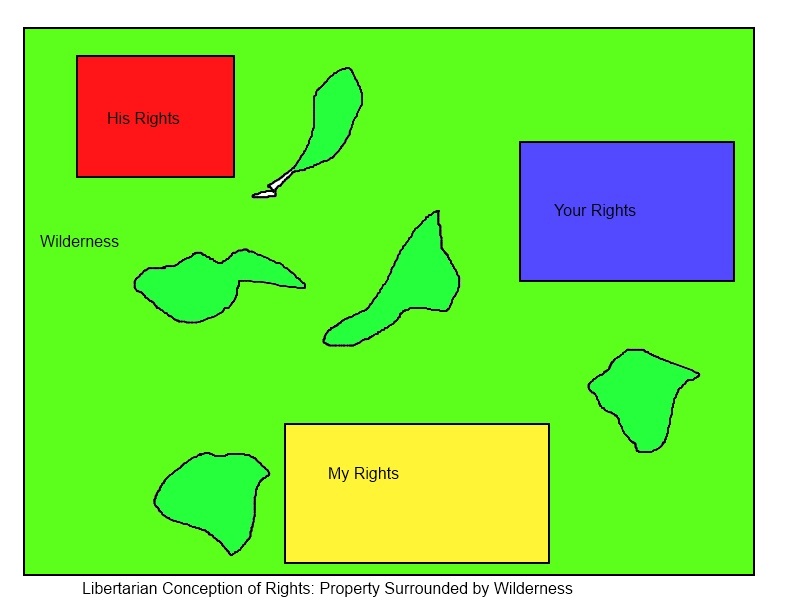
Contrasting the archetype of the wilderness is what was happening "back east," or in Europe or other civilized places. (Or sissified places, depending on your point of view.) In that conception, there was no wilderness. Everything belonged to someone or other, so as soon as you go off your own land you are either in public space (which has its own rules of behavior) or you are on someone else's territory and quite possibly trespassing. That lends itself to a conception of rights, too, in which any action you take bumps into someone else, and a ruling is required (either legal or informal) as to whether you have a right to do that in the particular case. Here's a visual conception of that:

One of the purposes of government is to mediate disputes among citizens. That's why we have civil law; in severe cases, it's also why we have criminal law. Obviously, a lot more government will be needed when the reality of rights is similar to the second illustration than it will if it resembles the first.
Thursday, April 19, 2012
Revelation or Discovery? Two Models of Spiritual Truth
I don't much enjoy discussing religious matters with adherents of doctrinaire faiths such as the majority of Christians and Muslims (there are exceptions in both cases, of course), except when the mischievous imp in my personality takes over and prompts me to yank their chains. We come at spirituality, the doctrinaire and I, from completely different epistemological assumptions. It is therefor extremely difficult to find common ground or any basis for discussion. But examining these two diametrically opposed ways of approaching the truth can perhaps be useful and instructive.
My own approach is one of discovery. I hold the sacred reality which is variously (and always metaphorically) termed God, the Gods, or other words for principles underlying the reality that we sense and in which we live, to be something that, while never possible for the human mind to encompass in its totality, we can discover. It lies at the bottom of our own being and at the core of the world's essence. The process of discovering it is also a process both of self-discovery and of self-transformation, in which the mind grows wider, deeper, more perceptive, and better able to embrace and understand. The discovery of the sacred is a stretching of the mind. It's the only thing that allows sacred reality to be comprehended at all, in my view.
Since sacred reality is there to be discovered, everyone who discovers it finds the same reality, even though the process of discovery varies. As an old Japanese proverb has it, there are many paths up the mountain, but the view of the moon from the top is the same. This is why mystics of all sorts, no matter what their starting-point religion, always end up saying very similar things and recognizing the oneness of all faiths.
I view spirituality as like a wheel, in which sacred reality is at the hub, while normal consciousness resides out on the rim. Religions are like the spokes of the wheel, bridging the rim and the hub. Each spoke is most distinct from the other spokes at the rim, at the shallow end of perception, and approaches common ground the closer it approaches the hub of the wheel, where God is.
All of this makes perfect sense to me, but it rests on the epistemological assumption that discovery is the way to know sacred reality. The doctrinaire make a different assumption: that sacred reality cannot be discovered, but can be known only by revelation.
Revelation is not a human act but a divine one. It involves sacred reality revealing itself to a prophet such as Moses, Jesus, or Mohammed, who communicates this reality to others in words and symbols. The more thoughtful among the doctrinaire recognize, as I do, that ultimately the sacred reality is unknowable, but they disagree with me that it can even be approached through human effort. The inadequacy of revelation for complete knowledge is acknowledged, but of course the same is true for discovery; when it comes to sacred reality there is no such thing as "complete knowledge."
An epistemological divide is essentially unbridgeable, because neither side acknowledges the proofs of the other as valid. Each side has its own way of knowing, and hence its own way of proving. There are perhaps some observations I can make about problems with the revelation mode of knowing, but when people begin with the assumption that a certain body of written word is revealed truth, there is not much more to be said, is there? Still, the effort should be made, if nothing else to clarify my own thoughts.
One problem with revelation is correctly identifying genuine revelation and distinguishing it from pretenders. Consider the Bible, for example. This is a collection of short books in three different languages (Hebrew, Biblical Aramaic, and ancient Greek) by many different authors. At some time in the dim past, Jewish authorities have identified the five books of the Torah (Genesis, Exodus, Leviticus, Numbers, and Deuteronomy) as sacred, with lesser degrees of sacredness applied to the Biblical historical accounts, the five books of poetry and philosophy (Job, Psalms, Proverbs, Ecclesiastes, and the Song of Songs), and the books of the major and minor Prophets. The Imperial Church at its founding in 325 or shortly thereafter adopted all of these books from the Jews without distinguishing among them in Jewish fashion, simply saying that they were all equally sacred, and added a selection of Christian writings chosen from among the many in circulation at the time: four Gospels, one history of the very early Church, a number of letters of instruction from Paul of Tarsus and several of the Apostles to various Christians, and one (very weird) book of prophecy. In each case, we have the testimony of various authority figures, backed by the government either of the Kings of Judea or of the Roman Empire, that these writings are to be taken as sacred.
So the first question is simply this: Why should we believe them? On what basis should we conclude that politicians (as we must regard these men) are proper judges of spiritual validity? Today's politicians certainly don't inspire a lot of confidence along those lines. I mean, would you accept the word of President Obama that a particular text revealed the truth of the Gods? Not I, and I say that as someone who voted for him. I voted for him for President of the United States, not for Supreme Spiritual Leader and Prophet. Nor would I consider him an appropriate choice for the latter office.
If we cannot trust the enlightenment of those who have chosen the sacred books, how can we take their word for it that the books are sacred? How can we be sure that they chose correctly among the various possibilities?
Another problem arises when we examine the texts of alleged sacred books themselves, and I am not referring here to contradictions or clearly non-factual statements (those are open to interpretation or to the recognition that sacred writing is neither science nor history). I am referring to cases in which the alleged revelatory text seems to itself endorse a discovery approach. Many of the parables of Jesus seem to point that direction, as does his encouragement to the Apostles to develop their own relationship with God, to recognize the presence of God within them, and to draw upon this presence through faith to accomplish miracles similar to (and even greater than) what Jesus himself is said to have done. Jesus himself seems to have endorsed a discovery method for identifying sacred truth, so isn't the allegedly sacred text itself contradicting, here and in other places, the claims of those who swear by it?
Finally, let's recognize that all sacred writings had human authors. Each human author, if the claims of the revelationists are correct, had a direct relationship with and/or experience of sacred reality, from which he derived the written word. As this sort of relationship and experience is what discovery advocates like myself are talking about, revelation draws upon the same source -- but at second hand rather than directly. If discovery cannot suffice to gain the truth, then neither can revelation, because revelation depends on discovery ultimately.
All of these arguments seem good to me, but I know very well that they will not persuade the doctrinaire, because the application of logic and evidence are themselves inappropriate to a revelation-based epistemic model, except insofar as logic reasons from the premise that the text is sacred, and evidence draws upon the words of the sacred writings themselves, without questioning their validity (only their interpretation). It is in the end a pointless exercise, except insofar as it helps our own thoughts to be clear.
My own approach is one of discovery. I hold the sacred reality which is variously (and always metaphorically) termed God, the Gods, or other words for principles underlying the reality that we sense and in which we live, to be something that, while never possible for the human mind to encompass in its totality, we can discover. It lies at the bottom of our own being and at the core of the world's essence. The process of discovering it is also a process both of self-discovery and of self-transformation, in which the mind grows wider, deeper, more perceptive, and better able to embrace and understand. The discovery of the sacred is a stretching of the mind. It's the only thing that allows sacred reality to be comprehended at all, in my view.
Since sacred reality is there to be discovered, everyone who discovers it finds the same reality, even though the process of discovery varies. As an old Japanese proverb has it, there are many paths up the mountain, but the view of the moon from the top is the same. This is why mystics of all sorts, no matter what their starting-point religion, always end up saying very similar things and recognizing the oneness of all faiths.
I view spirituality as like a wheel, in which sacred reality is at the hub, while normal consciousness resides out on the rim. Religions are like the spokes of the wheel, bridging the rim and the hub. Each spoke is most distinct from the other spokes at the rim, at the shallow end of perception, and approaches common ground the closer it approaches the hub of the wheel, where God is.
All of this makes perfect sense to me, but it rests on the epistemological assumption that discovery is the way to know sacred reality. The doctrinaire make a different assumption: that sacred reality cannot be discovered, but can be known only by revelation.
Revelation is not a human act but a divine one. It involves sacred reality revealing itself to a prophet such as Moses, Jesus, or Mohammed, who communicates this reality to others in words and symbols. The more thoughtful among the doctrinaire recognize, as I do, that ultimately the sacred reality is unknowable, but they disagree with me that it can even be approached through human effort. The inadequacy of revelation for complete knowledge is acknowledged, but of course the same is true for discovery; when it comes to sacred reality there is no such thing as "complete knowledge."
An epistemological divide is essentially unbridgeable, because neither side acknowledges the proofs of the other as valid. Each side has its own way of knowing, and hence its own way of proving. There are perhaps some observations I can make about problems with the revelation mode of knowing, but when people begin with the assumption that a certain body of written word is revealed truth, there is not much more to be said, is there? Still, the effort should be made, if nothing else to clarify my own thoughts.
One problem with revelation is correctly identifying genuine revelation and distinguishing it from pretenders. Consider the Bible, for example. This is a collection of short books in three different languages (Hebrew, Biblical Aramaic, and ancient Greek) by many different authors. At some time in the dim past, Jewish authorities have identified the five books of the Torah (Genesis, Exodus, Leviticus, Numbers, and Deuteronomy) as sacred, with lesser degrees of sacredness applied to the Biblical historical accounts, the five books of poetry and philosophy (Job, Psalms, Proverbs, Ecclesiastes, and the Song of Songs), and the books of the major and minor Prophets. The Imperial Church at its founding in 325 or shortly thereafter adopted all of these books from the Jews without distinguishing among them in Jewish fashion, simply saying that they were all equally sacred, and added a selection of Christian writings chosen from among the many in circulation at the time: four Gospels, one history of the very early Church, a number of letters of instruction from Paul of Tarsus and several of the Apostles to various Christians, and one (very weird) book of prophecy. In each case, we have the testimony of various authority figures, backed by the government either of the Kings of Judea or of the Roman Empire, that these writings are to be taken as sacred.
So the first question is simply this: Why should we believe them? On what basis should we conclude that politicians (as we must regard these men) are proper judges of spiritual validity? Today's politicians certainly don't inspire a lot of confidence along those lines. I mean, would you accept the word of President Obama that a particular text revealed the truth of the Gods? Not I, and I say that as someone who voted for him. I voted for him for President of the United States, not for Supreme Spiritual Leader and Prophet. Nor would I consider him an appropriate choice for the latter office.
If we cannot trust the enlightenment of those who have chosen the sacred books, how can we take their word for it that the books are sacred? How can we be sure that they chose correctly among the various possibilities?
Another problem arises when we examine the texts of alleged sacred books themselves, and I am not referring here to contradictions or clearly non-factual statements (those are open to interpretation or to the recognition that sacred writing is neither science nor history). I am referring to cases in which the alleged revelatory text seems to itself endorse a discovery approach. Many of the parables of Jesus seem to point that direction, as does his encouragement to the Apostles to develop their own relationship with God, to recognize the presence of God within them, and to draw upon this presence through faith to accomplish miracles similar to (and even greater than) what Jesus himself is said to have done. Jesus himself seems to have endorsed a discovery method for identifying sacred truth, so isn't the allegedly sacred text itself contradicting, here and in other places, the claims of those who swear by it?
Finally, let's recognize that all sacred writings had human authors. Each human author, if the claims of the revelationists are correct, had a direct relationship with and/or experience of sacred reality, from which he derived the written word. As this sort of relationship and experience is what discovery advocates like myself are talking about, revelation draws upon the same source -- but at second hand rather than directly. If discovery cannot suffice to gain the truth, then neither can revelation, because revelation depends on discovery ultimately.
All of these arguments seem good to me, but I know very well that they will not persuade the doctrinaire, because the application of logic and evidence are themselves inappropriate to a revelation-based epistemic model, except insofar as logic reasons from the premise that the text is sacred, and evidence draws upon the words of the sacred writings themselves, without questioning their validity (only their interpretation). It is in the end a pointless exercise, except insofar as it helps our own thoughts to be clear.
Monday, April 16, 2012
The Devil and Dualism: or, Having One's Cake and Eating It, Too
Emerging from some discussions with evangelical Christians and Catholics on another forum regarding the subject of Hell and the Devil has prompted some thoughts a bit too complex for that forum, but worth pursuing. So I will pursue them here.
The Devil/Hell complex of ideas in traditional Christianity is similar to -- yet different from in a fundamental way -- the older Zoroastrian concept of a division of the universe into good and evil principles. Ahura Mazda and Ahriman were thought of as equal principles, equal in power, knowledge, and wisdom, engaged in a conflict throughout the ages. In this way, Zoroaster resolved the philosophical conundrum of how God can be both all good and all powerful, given the existence of evil. His perfectly logical conclusion was to surrender half the goal: God (Ahura Mazda) is all good, but he is not all powerful. He has an opponent who is just as strong and completely independent of his will, and from this opponent come all wickedness and misfortune.
Christians resolve the same conundrum somewhat more problematically by the device of free will, stating that God, although all powerful, cannot do what is logically self-contradictory; he cannot at the same time make human beings free and remove their capacity for sin. This works as an explanation for human evil, but not for misfortune or suffering that comes from a source outside humanity. Most especially, it does not work for the Christian idea of Hell.
The Devil, in Christian theology, acts by divine permission. He can do nothing that God does not allow. Hence, everything done by the Devil is, at one remove, an act of God, insofar as people (including God) are responsible for their sins of omission as well as of commission. Hell is the work of God; God sends people to suffer in perpetuity. Sin may be an inevitable outcome of free will. Sin's punishment, certainly that particular outrageous punishment, is not. And so through the theological device of Hell, Christians re-introduce the philosophical conundrum that Zoroaster resolved. The God of Christians, if he indeed created Hell and sentences sinners (or, even worse, mere unbelievers) to that immeasurably draconian fate, is not all good. Or, if he did not, if Hell is the work of the Devil, acting independently of God and in ways God cannot prevent, then God is not all powerful. He has become more like Ahura Mazda, only a co-creator of the world along with a principle of evil that is just as strong.
Some Christian theological ideas do paint God as not being all powerful. One idea is that God cannot touch or be in contact with sin. Thus, it is said, God cannot embrace or accept sinners into his presence in Heaven, unless their sins are covered by the blood of Christ. Leaving aside the savagely sanguine quality of that image for the moment, here we are faced with a limitation on the power of God. There is something that he cannot do, which is not logically self-contradictory. God is not all powerful. And yet, faced with this question in words, Christians would deny it. Yet if it is not so -- if God is all powerful -- then either God is not all good (indeed, is a monstrous tyrant worse than any mere human tyrant who has ever lived), or there is no Hell.
The question must be asked why Christians devised the idea of Hell in the first place. It is a strictly Christian idea, rather than one derived from the three sources of ancient Roman Christianity (Judaism, the teachings of Jesus, and Greco-Roman paganism). Judaism has nothing like it, indeed no concept of an afterlife at all. The teachings of Jesus as reported in the Gospels contain some images and metaphors that could slant that direction, but no clear statement that the soul of the sinner or unbeliever is punished perpetually after death (and there are much better and more likely interpretations of his metaphors). Greco-Roman paganism contained some limited ideas of divine punishment after death, but only in extraordinary cases of people who had severely offended the Gods, and even they (Sisyphus, Tantalus) received punishments that came nowhere near the perpetual torture inflicted on the mildest of offenders in Christian theology. In fact, nowhere even in the New Testament is this idea clearly set forth. So why did Christians develop and implement it?
The most likely answer is that, like the belief in Christian exclusive possession of the truth itself, Hell was a device for enforcing the power and authority of the Imperial Church, or of the proto-authorities that pre-existed it and emerged to dominance by means of it. As the power of the Imperial Church and of the Roman Catholic and Eastern Orthodox Churches into which it split fades, as separation of church and state becomes the norm worldwide, more and more Christians today seem to be abandoning the idea of Hell, or at least modifying it so that it is less offensive to civilized concepts of morality.
Continuing along these lines of thought, what of the very idea of dividing the world into principles set by moral judgment? Granted that for humans, judging the value, the goodness or badness, of events, behavior, and each other is part of who we are and something fundamental to our societies, is it really right to say that it is fundamental to the cosmos itself? Is there any evidence that the universe is either good or evil, in terms that are meaningful to human moral judgments? And if it is not, does it make any sense to apply terms like that to personifications of the universe such as God or the Gods? What of that other pole of the philosophical conundrum? Could it be that God is indeed all powerful, but is not all good? This is the solution that Ahura Mazda rejected and that most religious people of any religion do, too. But perhaps it is the most sensible conclusion.
The idea of God as not good but beyond good, the idea that human judgments simply have no meaning when applied to God, has a beautifully poetic expression in the Book of Job. "Will we receive good from God but not also receive bad?" (Job 2:10). In the discussion between Job and his friends, much time is given to examining the mysterious work of God in visiting suffering on the good as well as the evil, or good fortune on the wicked as well as the just. By his works, God cannot be judged either good or evil. In the end, after much interesting discussion among the friends, God emerges from a whirlwind and declares himself a mystery not to be judged by the standards of men. "Where were you when I laid the earth’s foundations?
Tell me if you know. Who set its measurements? Surely you know. Who stretched a measuring tape on it? On what were its footings sunk; who laid its cornerstone, while the morning stars sang in unison and all the divine beings shouted?"
A child, in the custody and protection of its parents, has a simplistic idea of morality as coming from its parents, from outside itself, but in maturity takes responsibility for its own judgments. Similarly the idea of morality as laid down by the Gods is one for an immature civilization; but it is not nature, not the Gods, and not God who sets out standards of good and evil. We do that ourselves, and rightly so, by our own authority, according to what seems good to us. As our civilization gropes its stumbling way towards maturity, perhaps we have reached a point now when we may assume that responsibility, and see good and evil as a product of human judgment rather than of the Gods.
The Gods, like nature, are neither good nor evil. The Gods, like nature, are wild.
The Devil/Hell complex of ideas in traditional Christianity is similar to -- yet different from in a fundamental way -- the older Zoroastrian concept of a division of the universe into good and evil principles. Ahura Mazda and Ahriman were thought of as equal principles, equal in power, knowledge, and wisdom, engaged in a conflict throughout the ages. In this way, Zoroaster resolved the philosophical conundrum of how God can be both all good and all powerful, given the existence of evil. His perfectly logical conclusion was to surrender half the goal: God (Ahura Mazda) is all good, but he is not all powerful. He has an opponent who is just as strong and completely independent of his will, and from this opponent come all wickedness and misfortune.
Christians resolve the same conundrum somewhat more problematically by the device of free will, stating that God, although all powerful, cannot do what is logically self-contradictory; he cannot at the same time make human beings free and remove their capacity for sin. This works as an explanation for human evil, but not for misfortune or suffering that comes from a source outside humanity. Most especially, it does not work for the Christian idea of Hell.
The Devil, in Christian theology, acts by divine permission. He can do nothing that God does not allow. Hence, everything done by the Devil is, at one remove, an act of God, insofar as people (including God) are responsible for their sins of omission as well as of commission. Hell is the work of God; God sends people to suffer in perpetuity. Sin may be an inevitable outcome of free will. Sin's punishment, certainly that particular outrageous punishment, is not. And so through the theological device of Hell, Christians re-introduce the philosophical conundrum that Zoroaster resolved. The God of Christians, if he indeed created Hell and sentences sinners (or, even worse, mere unbelievers) to that immeasurably draconian fate, is not all good. Or, if he did not, if Hell is the work of the Devil, acting independently of God and in ways God cannot prevent, then God is not all powerful. He has become more like Ahura Mazda, only a co-creator of the world along with a principle of evil that is just as strong.
Some Christian theological ideas do paint God as not being all powerful. One idea is that God cannot touch or be in contact with sin. Thus, it is said, God cannot embrace or accept sinners into his presence in Heaven, unless their sins are covered by the blood of Christ. Leaving aside the savagely sanguine quality of that image for the moment, here we are faced with a limitation on the power of God. There is something that he cannot do, which is not logically self-contradictory. God is not all powerful. And yet, faced with this question in words, Christians would deny it. Yet if it is not so -- if God is all powerful -- then either God is not all good (indeed, is a monstrous tyrant worse than any mere human tyrant who has ever lived), or there is no Hell.
The question must be asked why Christians devised the idea of Hell in the first place. It is a strictly Christian idea, rather than one derived from the three sources of ancient Roman Christianity (Judaism, the teachings of Jesus, and Greco-Roman paganism). Judaism has nothing like it, indeed no concept of an afterlife at all. The teachings of Jesus as reported in the Gospels contain some images and metaphors that could slant that direction, but no clear statement that the soul of the sinner or unbeliever is punished perpetually after death (and there are much better and more likely interpretations of his metaphors). Greco-Roman paganism contained some limited ideas of divine punishment after death, but only in extraordinary cases of people who had severely offended the Gods, and even they (Sisyphus, Tantalus) received punishments that came nowhere near the perpetual torture inflicted on the mildest of offenders in Christian theology. In fact, nowhere even in the New Testament is this idea clearly set forth. So why did Christians develop and implement it?
The most likely answer is that, like the belief in Christian exclusive possession of the truth itself, Hell was a device for enforcing the power and authority of the Imperial Church, or of the proto-authorities that pre-existed it and emerged to dominance by means of it. As the power of the Imperial Church and of the Roman Catholic and Eastern Orthodox Churches into which it split fades, as separation of church and state becomes the norm worldwide, more and more Christians today seem to be abandoning the idea of Hell, or at least modifying it so that it is less offensive to civilized concepts of morality.
Continuing along these lines of thought, what of the very idea of dividing the world into principles set by moral judgment? Granted that for humans, judging the value, the goodness or badness, of events, behavior, and each other is part of who we are and something fundamental to our societies, is it really right to say that it is fundamental to the cosmos itself? Is there any evidence that the universe is either good or evil, in terms that are meaningful to human moral judgments? And if it is not, does it make any sense to apply terms like that to personifications of the universe such as God or the Gods? What of that other pole of the philosophical conundrum? Could it be that God is indeed all powerful, but is not all good? This is the solution that Ahura Mazda rejected and that most religious people of any religion do, too. But perhaps it is the most sensible conclusion.
The idea of God as not good but beyond good, the idea that human judgments simply have no meaning when applied to God, has a beautifully poetic expression in the Book of Job. "Will we receive good from God but not also receive bad?" (Job 2:10). In the discussion between Job and his friends, much time is given to examining the mysterious work of God in visiting suffering on the good as well as the evil, or good fortune on the wicked as well as the just. By his works, God cannot be judged either good or evil. In the end, after much interesting discussion among the friends, God emerges from a whirlwind and declares himself a mystery not to be judged by the standards of men. "Where were you when I laid the earth’s foundations?
Tell me if you know. Who set its measurements? Surely you know. Who stretched a measuring tape on it? On what were its footings sunk; who laid its cornerstone, while the morning stars sang in unison and all the divine beings shouted?"
A child, in the custody and protection of its parents, has a simplistic idea of morality as coming from its parents, from outside itself, but in maturity takes responsibility for its own judgments. Similarly the idea of morality as laid down by the Gods is one for an immature civilization; but it is not nature, not the Gods, and not God who sets out standards of good and evil. We do that ourselves, and rightly so, by our own authority, according to what seems good to us. As our civilization gropes its stumbling way towards maturity, perhaps we have reached a point now when we may assume that responsibility, and see good and evil as a product of human judgment rather than of the Gods.
The Gods, like nature, are neither good nor evil. The Gods, like nature, are wild.
Monday, February 27, 2012
Why Capitalism is Doomed
Heh -- I love a nice attention-grabbing title. :)
On this occasion, though, it's meant literally. Capitalism is doomed, and what's dooming it is the advance of technology.
Capitalism is an economic system characterized by private ownership of the means of production and the defining of ownership of goods by who owns the capital that is used to produce the goods. That's a fancy and technical way of saying that it's a system designed to facilitate rich people getting richer. As with any economic system, capitalism rests upon government action that sets the rules of the game.
Now, in theory, we have a democracy in this country, so government action must pass public muster. We must therefore recognize that capitalism exists on public sufferance, and at such time as that sufferance is removed, it will cease to exist and be replaced by a different economic system.
Which bring up another question: why was capitalism allowed to exist in the first place? I mean, if you were to go to the average working stiff on the street and ask, "Would you be willing to pay taxes, fight wars, and work like a slave your whole life so a few fat cats can get even richer?" the answer would surely be "Hell, no!" Yet people did support the system for a long time, and there was in fact a good, self-interested reason to do so.
Capitalism depends on a social compact, as does government itself. It's an unwritten compact impossible to enforce legally, but well understood by the people. The agreement went something like this. We allow a few rich people to control the nation's wealth, and to channel a large share of that wealth to themselves, and in return they will arrange things so that just about everyone enjoys rising standards of living throughout their lives and from generation to generation.
For a long time, it worked. The compact was kept, the promise fulfilled. Even during the Gilded Age or the Roaring Twenties, the heydey of unbridled laissez-faire capitalism, the era of trusts and monopolies and robber barons, high demand for labor meant that wages rose steadily. The system seemed to break down in the Great Depression, but it proved fixable by some moderate reforms: government regulations on business and encouragement of labor unions. The golden age of capitalism in America was in the decades after World War II, when high demand for labor coupled with strong unions kept wages high and climbing along with productivity. The rich got richer. So did the non-rich. Rising standards of living for almost everyone kept the people happy with the bargain. Capitalism, with proper controls, worked.
But in order to keep that compact, there is one essential factor. The production of wealth MUST require labor. It must be necessary for capitalists to share at least a nonzero amount of the wealth produced in order to produce the wealth at all. Given that, a labor-friendly government and strong unions can leverage this requirement into sharing of the wealth on an almost equitable scale.
Today, increasingly, we are divorcing the production of wealth from the work that used to be required to produce it. It's increasingly possible now to produce wealth without labor. We are well past the era of dumb machines replacing grunt work; today, sophisticated computer technology is replacing human labor for everything from typing to customer service to movie extras. (I've even seen software that can write articles. I have my worried eye on that, believe me.)
Technology can replace most of the work of lawyers other than actual appearance in court. Technology can replace much of a doctor's work apart from a bedside manner. Technology can replace all the craft of an artist short of true creative genius -- and I'm not even sure about that! We still have work in this economy: really high-paying professional work requiring advanced education, and really low-paying service work requiring nothing but a warm body and work ethic. But the middle-ground, decent-paying work that used to comprise the majority of the labor force is rapidly disappearing. We are fast approaching the time when the only jobs left are those too complicated to be worth the effort of automating, and those too low-paying to be worth the expense of doing so.
(A side note on outsourcing. As a practical matter, outsourcing is certainly a problem, but only because ridiculously cheap labor is available, so that it is more cost-effective to employ that labor than to automate the work. If for some reason the source of cheap labor abroad were to evaporate and the jobs had to be brought home, they would not stay here long, but would be replaced by machines as soon as practicable.)
Under these conditions, capitalism fails of its promise. The social compact on which its existence depends is broken. It no longer provides rising standards of living for most people. And that means the sufferance of the people is being withdrawn. It's already happening.
There is no way to restore the demand for labor that allowed its success in the past. Automated production is superior to labor-dependent production and the former will drive the latter out of business, so even if we were to adopt the most labor-friendly legislation imaginable, the problem would remain intractable. As long as we depend on wages paid for work to distribute wealth -- and capitalism entails that dependence -- we have lost forever a system that can promise rising standards of living for most people throughout their lives and from generation to generation. Instead, for most people, as long as capitalism remains in place, things will only get worse.
And that is unacceptable, and will not be accepted.
And that is why capitalism is doomed.
On this occasion, though, it's meant literally. Capitalism is doomed, and what's dooming it is the advance of technology.
Capitalism is an economic system characterized by private ownership of the means of production and the defining of ownership of goods by who owns the capital that is used to produce the goods. That's a fancy and technical way of saying that it's a system designed to facilitate rich people getting richer. As with any economic system, capitalism rests upon government action that sets the rules of the game.
Now, in theory, we have a democracy in this country, so government action must pass public muster. We must therefore recognize that capitalism exists on public sufferance, and at such time as that sufferance is removed, it will cease to exist and be replaced by a different economic system.
Which bring up another question: why was capitalism allowed to exist in the first place? I mean, if you were to go to the average working stiff on the street and ask, "Would you be willing to pay taxes, fight wars, and work like a slave your whole life so a few fat cats can get even richer?" the answer would surely be "Hell, no!" Yet people did support the system for a long time, and there was in fact a good, self-interested reason to do so.
Capitalism depends on a social compact, as does government itself. It's an unwritten compact impossible to enforce legally, but well understood by the people. The agreement went something like this. We allow a few rich people to control the nation's wealth, and to channel a large share of that wealth to themselves, and in return they will arrange things so that just about everyone enjoys rising standards of living throughout their lives and from generation to generation.
For a long time, it worked. The compact was kept, the promise fulfilled. Even during the Gilded Age or the Roaring Twenties, the heydey of unbridled laissez-faire capitalism, the era of trusts and monopolies and robber barons, high demand for labor meant that wages rose steadily. The system seemed to break down in the Great Depression, but it proved fixable by some moderate reforms: government regulations on business and encouragement of labor unions. The golden age of capitalism in America was in the decades after World War II, when high demand for labor coupled with strong unions kept wages high and climbing along with productivity. The rich got richer. So did the non-rich. Rising standards of living for almost everyone kept the people happy with the bargain. Capitalism, with proper controls, worked.
But in order to keep that compact, there is one essential factor. The production of wealth MUST require labor. It must be necessary for capitalists to share at least a nonzero amount of the wealth produced in order to produce the wealth at all. Given that, a labor-friendly government and strong unions can leverage this requirement into sharing of the wealth on an almost equitable scale.
Today, increasingly, we are divorcing the production of wealth from the work that used to be required to produce it. It's increasingly possible now to produce wealth without labor. We are well past the era of dumb machines replacing grunt work; today, sophisticated computer technology is replacing human labor for everything from typing to customer service to movie extras. (I've even seen software that can write articles. I have my worried eye on that, believe me.)
Technology can replace most of the work of lawyers other than actual appearance in court. Technology can replace much of a doctor's work apart from a bedside manner. Technology can replace all the craft of an artist short of true creative genius -- and I'm not even sure about that! We still have work in this economy: really high-paying professional work requiring advanced education, and really low-paying service work requiring nothing but a warm body and work ethic. But the middle-ground, decent-paying work that used to comprise the majority of the labor force is rapidly disappearing. We are fast approaching the time when the only jobs left are those too complicated to be worth the effort of automating, and those too low-paying to be worth the expense of doing so.
(A side note on outsourcing. As a practical matter, outsourcing is certainly a problem, but only because ridiculously cheap labor is available, so that it is more cost-effective to employ that labor than to automate the work. If for some reason the source of cheap labor abroad were to evaporate and the jobs had to be brought home, they would not stay here long, but would be replaced by machines as soon as practicable.)
Under these conditions, capitalism fails of its promise. The social compact on which its existence depends is broken. It no longer provides rising standards of living for most people. And that means the sufferance of the people is being withdrawn. It's already happening.
There is no way to restore the demand for labor that allowed its success in the past. Automated production is superior to labor-dependent production and the former will drive the latter out of business, so even if we were to adopt the most labor-friendly legislation imaginable, the problem would remain intractable. As long as we depend on wages paid for work to distribute wealth -- and capitalism entails that dependence -- we have lost forever a system that can promise rising standards of living for most people throughout their lives and from generation to generation. Instead, for most people, as long as capitalism remains in place, things will only get worse.
And that is unacceptable, and will not be accepted.
And that is why capitalism is doomed.
Thursday, December 29, 2011
Mysticism, Myth and Make-Believe
Religious teachings and ideas consist of three things: mysticism, myth, and make-believe. Or, as I've said somewhat less precisely in another context, inspired wisdom and comic-book stuff.
Where does religion originally come from? Of course one may provide a cynical answer to this question; one may assert that religion comes from a desire for power on the part of a priesthood, or from a desire to explain the unexplained, or from a desire for immortality or fear of death, or from a desire for certainty in an uncertain world. But while all of these are factors in determining the beliefs that make up a religion, there is one other element without which religion wouldn't even exist: mysticism.
By "mysticism" I mean the direct personal experience of -- well, of those things that mystics experience. Call it the Underlying Reality, or UR for short. Any words I might use to describe exactly what the UR is would be metaphorical at best and misleading at worst. If you reading this have undergone mystical experience, you know what I mean. If you haven't, unfortunately, I can't tell you. But there are states of consciousness which the human mind can achieve either spontaneously or by various methods, and in which one comes to an intuitive understanding regarding one's identity and place in the cosmos. Mystical awareness has been called many things: communion with God, union with God, communion or union with the universe, eradication of the ego or of the self, awakening from sleep or from a dream, penetration of the illusion to find reality. All of these are metaphors, which is why I'm using a vague term here like UR, which really doesn't mean anything and so, if it fails to inform, should at least also not confuse. Again, if you've been there, you know.
One thing that has sometimes happened is that mystics have felt a compulsion to communicate their teachings to other people. I guess most of us go through that desire at some point or other (and look, here I am surrendering to it yet again). Something interesting happens when they do. Two interesting things, actually. The first is that hardly anyone understands them (only other mystics, who don't need the instruction, can really comprehend it). But the second is that what they say often resonates with a kind of unconscious awareness we all have. It's as if the understanding of mystics is stored inside our brains where we can't normally get at it, and pops up to say "Hey! Here I am!" whenever it gets any encouragement. And so when a person reads a parable of Jesus from the Gospels or the teachings of the Buddha from the Sutras or the Tao Te Ching by Lao Tze or some of the more seminal passages of the Baghavad Gita, the thoughts expressed in those words touch off little explosions deep inside the soul. And so the mystics attract followers who don't really understand what their teacher or guru or whatever is talking about, but know that they like it and want to follow it.
And then another thing happens when the mystic teacher dies, as is of course inevitable. The written teachings are then all that's left, and there is usually no one around anymore who really understands them, but there remain enthusiastic followers who want to believe. And that's where all those other contributions to religious thought come in: the desire for power, to explain the unexplained, to deny death, or to achieve certainty.
Now, within most religions or at least within an esoteric branch of them one can always find a framework for pursuing mystical enlightenment, together with techniques for achieving it. Since it's only possible to know the UR by personally experiencing it, this sort of instruction within a religion -- instruction as to how to personally experience it -- is the only religious knowledge that can be conveyed directly and straightforwardly. That's mysticism: the first category of religious teaching.
One can also find plenty of myth, and by that I mean ideas and stories that provide metaphorical descriptions of the UR or some aspect of it. Myths, like the teachings of great mystics, resonate in the brain's hidden recesses. But we must always remember that myths are metaphors; its their resonance with the buried mystical awareness that's important, not their literal truth. The central Christian myth of the Resurrection is a perfect example. Many Christians actually believe that Jesus literally rose from the dead; I regard that as extremely improbable for obvious reasons, but that's not really the point here. The point is that the Resurrection as myth is more important than the Resurrection as fact even if it IS fact. What this story says about the process of awakening and the experience a mystic goes through to come to that point is what's important here. And the same is true of other myths in other religions. It's not important whether the Buddha was actually raised with such imposed naivety that he never saw sickness or poverty or death until he became a teenager and jumped over Daddy's royal wall. (Yeah, like he never suffered a childhood disease . . .) It's not important whether his mother had a dream in which she was impregnated by a white elephant. It's not important whether Moses really brought monstrous plagues down on Egypt or caused the sea to part or obtained God's will inscribed on stone tablets by the divine hand itself. What's important in every case is the symbolic power of these stories, the way they resonate (once again) with that hidden knowledge we all carry.
The final category of religious thought is make-believe. Now, make-believe can have the same contents as myth sometimes. In fact, that's very often the case. Those that believe a myth to be literally real and (more importantly) make a big deal of this, so that it sets their religion apart from all others, are engaging in make-believe.
Make-believe in religious thought and teachings generates a narrative that aggrandizes a religon's power and importance.
God, the creator of the universe, selected one particular tribe of humans as his particular servants, and expects more of them than from others, and visits them with blessings when they live up to these expectations and with tribulations when they fall short.
God sent his son to sacrifice himself for the sins of the world, so that those who follow his religion can be saved from hell and achieve eternal life in bliss.
God has addressed mankind via a series of prophets, and we who follow the last of the prophets have his real, true teachings, all previous prophetic teachings having been either superseded or corrupted or both.
See the pattern? In reality, awareness of the UR is something that all human beings have as a potential. It's there, separate from any religion, ready to guide and lead. The experience of finding it is something often hinted at in the teachings of all religions, and all religions should consider themselves to be signposts pointing the way towards the reality at which they can only hint. When all religious teachings are properly understood to be what they are -- myths and metaphors -- how can any religion ever claim to possess THE truth, or to be true while all others are false? Literally speaking, there is no such thing as a "true metaphor." (Or, of course, a false one.) When a religion takes this kind of humble approach and accepts that its teachings are not THE truth, but only one version, one myth, one pointer towards the knowable-but-not-tellable, then it will leave make-believe behind and deal only in mysticism and myth.
But when it obsesses over the make-believe aspects of its teachings, then it ceases to be a guide to the UR and becomes a barrier between it and the believer. And that is also when it becomes potentially something dangerous.
No matter how sophisticated our knowledge of the universe becomes, there will always be a place for both mysticism and myth. But there really should be no place for make-believe outside of fiction.
Where does religion originally come from? Of course one may provide a cynical answer to this question; one may assert that religion comes from a desire for power on the part of a priesthood, or from a desire to explain the unexplained, or from a desire for immortality or fear of death, or from a desire for certainty in an uncertain world. But while all of these are factors in determining the beliefs that make up a religion, there is one other element without which religion wouldn't even exist: mysticism.
By "mysticism" I mean the direct personal experience of -- well, of those things that mystics experience. Call it the Underlying Reality, or UR for short. Any words I might use to describe exactly what the UR is would be metaphorical at best and misleading at worst. If you reading this have undergone mystical experience, you know what I mean. If you haven't, unfortunately, I can't tell you. But there are states of consciousness which the human mind can achieve either spontaneously or by various methods, and in which one comes to an intuitive understanding regarding one's identity and place in the cosmos. Mystical awareness has been called many things: communion with God, union with God, communion or union with the universe, eradication of the ego or of the self, awakening from sleep or from a dream, penetration of the illusion to find reality. All of these are metaphors, which is why I'm using a vague term here like UR, which really doesn't mean anything and so, if it fails to inform, should at least also not confuse. Again, if you've been there, you know.
One thing that has sometimes happened is that mystics have felt a compulsion to communicate their teachings to other people. I guess most of us go through that desire at some point or other (and look, here I am surrendering to it yet again). Something interesting happens when they do. Two interesting things, actually. The first is that hardly anyone understands them (only other mystics, who don't need the instruction, can really comprehend it). But the second is that what they say often resonates with a kind of unconscious awareness we all have. It's as if the understanding of mystics is stored inside our brains where we can't normally get at it, and pops up to say "Hey! Here I am!" whenever it gets any encouragement. And so when a person reads a parable of Jesus from the Gospels or the teachings of the Buddha from the Sutras or the Tao Te Ching by Lao Tze or some of the more seminal passages of the Baghavad Gita, the thoughts expressed in those words touch off little explosions deep inside the soul. And so the mystics attract followers who don't really understand what their teacher or guru or whatever is talking about, but know that they like it and want to follow it.
And then another thing happens when the mystic teacher dies, as is of course inevitable. The written teachings are then all that's left, and there is usually no one around anymore who really understands them, but there remain enthusiastic followers who want to believe. And that's where all those other contributions to religious thought come in: the desire for power, to explain the unexplained, to deny death, or to achieve certainty.
Now, within most religions or at least within an esoteric branch of them one can always find a framework for pursuing mystical enlightenment, together with techniques for achieving it. Since it's only possible to know the UR by personally experiencing it, this sort of instruction within a religion -- instruction as to how to personally experience it -- is the only religious knowledge that can be conveyed directly and straightforwardly. That's mysticism: the first category of religious teaching.
One can also find plenty of myth, and by that I mean ideas and stories that provide metaphorical descriptions of the UR or some aspect of it. Myths, like the teachings of great mystics, resonate in the brain's hidden recesses. But we must always remember that myths are metaphors; its their resonance with the buried mystical awareness that's important, not their literal truth. The central Christian myth of the Resurrection is a perfect example. Many Christians actually believe that Jesus literally rose from the dead; I regard that as extremely improbable for obvious reasons, but that's not really the point here. The point is that the Resurrection as myth is more important than the Resurrection as fact even if it IS fact. What this story says about the process of awakening and the experience a mystic goes through to come to that point is what's important here. And the same is true of other myths in other religions. It's not important whether the Buddha was actually raised with such imposed naivety that he never saw sickness or poverty or death until he became a teenager and jumped over Daddy's royal wall. (Yeah, like he never suffered a childhood disease . . .) It's not important whether his mother had a dream in which she was impregnated by a white elephant. It's not important whether Moses really brought monstrous plagues down on Egypt or caused the sea to part or obtained God's will inscribed on stone tablets by the divine hand itself. What's important in every case is the symbolic power of these stories, the way they resonate (once again) with that hidden knowledge we all carry.
The final category of religious thought is make-believe. Now, make-believe can have the same contents as myth sometimes. In fact, that's very often the case. Those that believe a myth to be literally real and (more importantly) make a big deal of this, so that it sets their religion apart from all others, are engaging in make-believe.
Make-believe in religious thought and teachings generates a narrative that aggrandizes a religon's power and importance.
God, the creator of the universe, selected one particular tribe of humans as his particular servants, and expects more of them than from others, and visits them with blessings when they live up to these expectations and with tribulations when they fall short.
God sent his son to sacrifice himself for the sins of the world, so that those who follow his religion can be saved from hell and achieve eternal life in bliss.
God has addressed mankind via a series of prophets, and we who follow the last of the prophets have his real, true teachings, all previous prophetic teachings having been either superseded or corrupted or both.
See the pattern? In reality, awareness of the UR is something that all human beings have as a potential. It's there, separate from any religion, ready to guide and lead. The experience of finding it is something often hinted at in the teachings of all religions, and all religions should consider themselves to be signposts pointing the way towards the reality at which they can only hint. When all religious teachings are properly understood to be what they are -- myths and metaphors -- how can any religion ever claim to possess THE truth, or to be true while all others are false? Literally speaking, there is no such thing as a "true metaphor." (Or, of course, a false one.) When a religion takes this kind of humble approach and accepts that its teachings are not THE truth, but only one version, one myth, one pointer towards the knowable-but-not-tellable, then it will leave make-believe behind and deal only in mysticism and myth.
But when it obsesses over the make-believe aspects of its teachings, then it ceases to be a guide to the UR and becomes a barrier between it and the believer. And that is also when it becomes potentially something dangerous.
No matter how sophisticated our knowledge of the universe becomes, there will always be a place for both mysticism and myth. But there really should be no place for make-believe outside of fiction.
Wednesday, December 21, 2011
Monday, December 5, 2011
The Premature Implosion of the GOP
This is an interesting election season that hasn't started yet. The important action of this election in its primary and caucus phase will of course be on the Republican side, as there is an incumbent Democratic president who has a lock on the nomination. So the fact that the Republicans are in the election news at this point is no surprise. What is rather surprising and, if I'm not mistaken, unprecedented is that the nomination is being largely decided before the first primary or caucus has been held.
Over the past few months, we have seen several Republican candidates rise in the polls only to sink again as either weird policy positions, poor debating performance, or skeletons emerging from their closets have lost them support among Republican voters. First it was Michelle Bachmann. She was riding high for a while, but doubts about her ability to handle the economy and the entry of Rick Perry into the race dramatically cut her support, and at this point she has little chance to win the nomination.
After Bachmann came Perry. A meteoric rise in the polls was followed by an equally-rapid fall as Perry revealed policy positions that were not in line with what Republican voters were looking for and displayed a truly clumsy and lamentable performance in the debates. Now Perry has sunk, too, but his fall has not resulted in a restoration of Bachmann as the political right's darling.
Instead, the focus moved to Herman Cain. Again, briefly, Cain was the man of the hour (the problem being that the hour occurred LONG before the nomination is to be officially decided). Cain has fallen, too (and unlike the others has actually suspended his campaign), partly because his gimmicky 9-9-9 tax plan looks awful to the degree people understand it, partly because of sexual indiscretions in his past.
Now, the white hat seems to be worn by Newt Gingrich, who has yet to implode and fall. But at this point, the first caucus of the campaign season is still almost a month away (Iowa is scheduled for January 3, 2012.) So there's still time for Gingrich, too, to self-destruct.
The Republican Party seems to be self-destructing, but what's particularly interesting to me is that this is happening so prematurely. The primary season hasn't even started yet, but the party is looking over and discarding candidate after candidate. It's as if the real decision occurs ahead of time through some other process, and the actual primaries and caucuses serve only as validations of that prior decision-making.
And that is in fact what I believe is happening. The decision-making is taking place largely over social media and Internet conversations among Republicans, in a form of Internet-based direct democracy. This is a variant of the same process that has given us the Arab Spring, the Occupy movement, and the amazing volatility of the stock markets over the past year.
What I believe we are seeing is a fundamental transformation in the way decisions are reached in our society. Institutions and values, culture and politics, all of these follow the lead of technological change. All adapt to material circumstances, and those circumstances are themselves altered by technology. When it comes to collective decision-making, communication technology is what's important. A simple and deceptively innocuous invention, the printing press, led first to a rebellion against the Catholic Church that split Christendom to the core, and later to a massive, wide-spread movement across Europe and America to replace monarchies with democratic republics. All this just from a technique for cheaply reproducing written material -- which made widespread literacy economically feasible and led to demands first for the right of believers to read Scripture for themselves, and then for participation by literate citizens in the political process.
The Internet is a similar widespread change, dramatically accelerating the ability of people to communicate and interact. That's especially true of social media, which permit two-way communication on a scale and at a speed unprecedented. This change increases the ability of people to reach collective decisions independent of official authorities and political processes -- and thereby increases the capacity for direct, as opposed to representative, democracy.
I've written a pamphlet on the subject of direct democracy on a national scale which you can download free from here. But perhaps the larger transformation is what is happening not on this scale, but under the hood. The Republican Party's voters are making their decision about their 2012 candidate before the year 2012 even begins, and they are doing it on line in discussions about the candidates outside the official channels.
Over the past few months, we have seen several Republican candidates rise in the polls only to sink again as either weird policy positions, poor debating performance, or skeletons emerging from their closets have lost them support among Republican voters. First it was Michelle Bachmann. She was riding high for a while, but doubts about her ability to handle the economy and the entry of Rick Perry into the race dramatically cut her support, and at this point she has little chance to win the nomination.
After Bachmann came Perry. A meteoric rise in the polls was followed by an equally-rapid fall as Perry revealed policy positions that were not in line with what Republican voters were looking for and displayed a truly clumsy and lamentable performance in the debates. Now Perry has sunk, too, but his fall has not resulted in a restoration of Bachmann as the political right's darling.
Instead, the focus moved to Herman Cain. Again, briefly, Cain was the man of the hour (the problem being that the hour occurred LONG before the nomination is to be officially decided). Cain has fallen, too (and unlike the others has actually suspended his campaign), partly because his gimmicky 9-9-9 tax plan looks awful to the degree people understand it, partly because of sexual indiscretions in his past.
Now, the white hat seems to be worn by Newt Gingrich, who has yet to implode and fall. But at this point, the first caucus of the campaign season is still almost a month away (Iowa is scheduled for January 3, 2012.) So there's still time for Gingrich, too, to self-destruct.
The Republican Party seems to be self-destructing, but what's particularly interesting to me is that this is happening so prematurely. The primary season hasn't even started yet, but the party is looking over and discarding candidate after candidate. It's as if the real decision occurs ahead of time through some other process, and the actual primaries and caucuses serve only as validations of that prior decision-making.
And that is in fact what I believe is happening. The decision-making is taking place largely over social media and Internet conversations among Republicans, in a form of Internet-based direct democracy. This is a variant of the same process that has given us the Arab Spring, the Occupy movement, and the amazing volatility of the stock markets over the past year.
What I believe we are seeing is a fundamental transformation in the way decisions are reached in our society. Institutions and values, culture and politics, all of these follow the lead of technological change. All adapt to material circumstances, and those circumstances are themselves altered by technology. When it comes to collective decision-making, communication technology is what's important. A simple and deceptively innocuous invention, the printing press, led first to a rebellion against the Catholic Church that split Christendom to the core, and later to a massive, wide-spread movement across Europe and America to replace monarchies with democratic republics. All this just from a technique for cheaply reproducing written material -- which made widespread literacy economically feasible and led to demands first for the right of believers to read Scripture for themselves, and then for participation by literate citizens in the political process.
The Internet is a similar widespread change, dramatically accelerating the ability of people to communicate and interact. That's especially true of social media, which permit two-way communication on a scale and at a speed unprecedented. This change increases the ability of people to reach collective decisions independent of official authorities and political processes -- and thereby increases the capacity for direct, as opposed to representative, democracy.
I've written a pamphlet on the subject of direct democracy on a national scale which you can download free from here. But perhaps the larger transformation is what is happening not on this scale, but under the hood. The Republican Party's voters are making their decision about their 2012 candidate before the year 2012 even begins, and they are doing it on line in discussions about the candidates outside the official channels.
Wednesday, July 27, 2011
The Roman Republic and the Three Forms of Government
Although there are, in one sense, many different forms of government – parliamentary democracies, unitary republics, federal republics, dictatorships, constitutional monarchies, absolute monarchies, oligarchic republics – in actual practice it comes down to just three archetypal forms, as one might put it. All real-world governments can be described in terms of how much they lean towards one or another of these ideal archetypes. The forms are monarchy, aristocracy and democracy. The key dynamic of all politics is the desire of aristocrats (with or without titles) to maximize their own power. Both monarchy and democracy are opposed to their doing this, and so aristocrats strive to limit the power of both kings and people, and to gather all control of the government and of life itself into their hands. In American national patriotic mythos (America being founded by an aristocratic rebellion against a monarchy), kings are portrayed as the enemies of popular liberty; in reality, though, while it’s true that kings, monarchs, dictators, absolute rulers in general, can at times be despots, for the most part they are a danger to aristocrats, not to the common people, who have more to fear from aristocrats than from kings.
As it happens, history holds a wonderful real-time example of how these three forms mix and what lessons we can learn from them.
That real-world example is Rome, which in its long life prior to the collapse of the Roman Empire was first a monarchy, then a naked aristocracy (very briefly), then an aristocracy with democratic pretensions, then a monarchy again. Rome does not give us anything approaching real (as opposed to pretend) democracy, but for the purposes of this writing that’s actually a benefit. Let me explain what I mean.
Rome began life as an agricultural and trading city-state on an Italian river and on a trade route for salt. Like most city-states, it was ruled by a monarch, but in the case of Rome, for a long time the monarch was a foreigner, an Etruscan, which nation had somehow established political control over central Italy, including Rome. The details of this we don’t know, but the usual structure of government in the city-states of the ancient world consisted of a class of hereditary nobles, whose wealth came from land holdings and who traditionally served as the city-state’s elite warriors and war-leaders, with a king at the top of the governing structure. That was the case with Rome, as we can see from the institutions which survived the overthrow of the monarchy. The King of Rome was advised by the Senate, which consisted of the heads of the great aristocratic families, originally an even one hundred in number. (It was increased in size later on.) The Senate possessed considerable power and authority, as did each Patrician (the original Roman nobility) in his own lands and over his own people. But the authority of the King served to moderate and mitigate that of the aristocrats.
There are stories told about the heinous tyranny of the seventh and last King of Rome, Lucius Tarquinius Superbus, which may or may not contain elements of truth. What is undeniably true is that, whether they were goaded by the rule of a particularly offensive monarch or for some other reason, towards the end of the sixth century BCE the Roman aristocrats overthrew their King and created a new government, the Roman Republic. (The conflict of interest between monarchs and aristocrats is illustrated by the stories of King Tarquinius. It’s said that he murdered members of the Senate whom he suspected of supporting his predecessor, King Servius Tullus, who had usurped the rule after the death of Tarquinius’ father, King Tarquinius Priscus, and failed to replace the murdered Senators with new members. It’s also said that he ruled without properly consulting the Senate, as an absolute monarch or, in the strict sense of the word, a tyrant. And finally, there’s a story that the King’s son raped a noblewoman named Lucretia, who then committed suicide, driving her widowed husband and her family to overthrow the king out of personal outrage.)
The story of the Republic’s founding, complete with the alleged perfidies of King Tarquinius Superbus, is presented by Roman writers and those sympathetic to the Republic in later times as a triumph of liberty. The reality is not so simple. We must always ask ourselves two questions. Liberty for whom? Liberty to do what?
What was the governing structure of the Roman Republic actually like? As we shall see, it was a structure designed to maintain aristocratic rule. To that end, it contained both anti-democratic and anti-monarchical structures. Some of its structures served to concentrate power in the hands of the nobility and exclude it from anyone outside those ranks, or from the common people as a whole. Other structures served as checks and balances designed to prevent any one aristocrat – as opposed to the class of aristocrats – from gaining too much power. If the people became strong, if a genuine democracy was created, the aristocrats might lose their power and privileges in the face of popular resentment. On the other hand, if any one aristocrat became too strong, he might make himself a king, and restrain aristocratic rapacity from above. The Republic, in short, was not designed to protect the liberty of the common people. It was designed to maximize the privileges of the aristocracy, and to subjugate and plunder the common people not to protect them. That was the reality, and any claim to the contrary was mere pretense.
The official or at least semi-official title of the Republic was “Senatus Populusque Romanus,” or “The Senate and the People of Rome.” The Senate continued to exist in more or less the same form and with more or less the same powers as it had possessed under the monarchy. The People were a new creation, or perhaps an evolution of something that had existed in embryonic form under the monarchy. Note the capitalization. The People of Rome were not the same thing as the people or Rome or the citizenry of Rome. It was a formal body, a name for four different legislative and judicial Assemblies that passed the laws and conducted many, although not all, trials. These Assemblies were, from oldest to youngest, the Curiate Assembly (Comitia Curiata), the Assembly of the Centuries (Comitia Centuriata), the Assembly of the People or of the Tribes (Comitia Tributa) and the Assembly of the Plebeians (Concilium Plebis) In addition to the Senate and the Assemblies, the Republic included various elected magistrates who presided over the day-to-day governing of the city.
The Curiate Assembly was really important only in the first twenty years of the Republic, before the Plebeian Revolt. In the beginning, this Assembly passed all the laws and elected the consuls (at this time the only magistrates, later on the most senior magistrates), and conducted trials. It consisted only of aristocrats, and so was a true, naked aristocratic body of rule. Here was the actual motivation behind the Roman revolution, blatantly – perhaps too blatantly – on display. Within two decades after the founding of the Republic, in the face of plebeian unrest, most of the powers of the Curiate Assembly were transferred to the other Assemblies, which (as we shall see) were in practice just as lopsidedly aristocratic, but could more successfully pretend otherwise.
The Assembly of the Centuries elected the highest magistrates, the consuls and praetors, after this power was transferred to it from the Curiate Assembly. It also conducted trials for high treason and could (but rarely did) pass legislation. In this Assembly, the voters were divided into economic classes, with the richest Roman citizens in the First Class, and those of lower means assigned to the Second through the Fifth Classes, while the poorest were denied any vote at all in this Assembly. Each Class was further divided into Centuries (hence the Assembly’s name), which for the First Class actually consisted of 100 men each. (Women could not vote. There were very few, if any, ancient societies that practiced voting that granted the franchise to women, so that was not especially noteworthy on the part of the Romans.) The number of men per Century increased through the classes, so that a Century of the Fifth Class consisted of many more men than one of the First Class. When electing magistrates or voting on a law, each member voted within his Century, and the majority within the Century determined the vote of that Century. Because of the variation in Century size from one Class to the next, the very wealthy Romans (which of course meant the aristocrats) had a more influential vote than the poorer citizens. Voting in this Assembly proceeded from the Centuries of the First Class on down. Most of the time, a majority of the Centuries was achieved by the time the first two Classes had voted, so that in practice very few Romans had a vote. But in theory, any Roman citizen except the very poorest had at least some voice in the Assembly, so, unlike the Curiate Assembly, it possessed a veneer, a pretense of democracy.
The Comitia Tributa or Assembly of the People had a different structure. It was not organized by wealth. Instead, each citizen belonged to one of the thirty-five “tribes” of the Roman people. But the common people were almost all lumped into four huge “urban” tribes (in fact, most of the common people were in just two of them), while the aristocrats were distributed across the thirty-one “rural” tribes. In elections and legislation, each citizen voted within his tribe, and it was his tribe’s vote, as determined by the majority of its citizens, that actually counted. What this means is that the common people had just four votes, while the aristocrats had thirty-one. But here again, a veneer or pretense of democracy existed, because every Roman citizen could vote. In fact, even the poorest Romans had a vote. It just didn’t count for anything.
The Concilium Plebis or Plebeian Assembly had a structure very much like the Assembly of the People, except that it excluded the Patricians from voting. The Patricians were the original Roman aristocrats. One could be a Patrician only by right of birth or adoption, and Patricians could not vote in the Plebeian Assembly. In the beginning, the Plebeian Assembly had no legislative powers; after the Plebeian Revolt, however, it was granted such powers – and at the same time, the nobility began to admit the very wealthiest of Plebeians into the ranks of the aristocrats. Such men were still not considered Patrician, but they could enter the Senate, could run for the magistracies, and had almost all of the same privileges as Patricians. And again, the rich, aristocratic Plebeians joined the Patricians in the thirty-one “rural” tribes, while everyone else still got dumped into the four “urban” tribes. Here we see the mechanism of control at its best and most deceptive. The Plebeian Assembly, in spite of these measures, could at times be a subversive, almost democratic body, but there were sufficient checks on its powers through cooption and rigged voting that most of the time it served to reinforce the powers of the aristocrats, even though many of those aristocrats could not vote in it.
These four Assemblies are what was meant by “the Roman People” in the official name of the Republic: not the collection of all Roman citizens in some democratic fashion, but rather the bodies that passed the laws, and were designed to maintain aristocratic rule.
The laws were all passed in one of the Assemblies or another. But the day-to-day running of the Republic was done by the magistrates and by the Senate. The Senate was originally restricted to Patrician membership, but at the same time as the rich Plebeians began to be coopted into the aristocracy, the door was opened for them to enter the Senate as well. Even so, the Senate remained a thoroughly aristocratic body, because only the richest of Romans could belong to it. Its decrees did not have the force of law, and could be overridden by a vote of an Assembly. But the Senate controlled the public purse, foreign policy, and military practice, and could direct the actions of the government on a regular basis as long as no Assembly actually did vote to override its authority. Here was the most aristocratic of the Republic’s governing institutions, with no pretense to democracy at all.
The magistrates were elected for one year at a time, and it is perhaps in them most of all that we can see the other side of the Republic’s protection of aristocratic power, because in them more than anything else resided the checks and balances that kept too much power out of the hands of any one man. Theoretically, any Roman citizen could run for any magistracy, but in practice most of the offices were reserved for aristocrats. Even the office of Tribune of the Plebeians was the prerogative of wealthy men and men with aristocratic names (although they could not be Patricians). As for the consuls, those at the head of the government, only the most august of families could in most cases stand any chance of running and winning.
But the power of any man who held high office was carefully circumscribed. The government was led not by one man but by two, both of whom held the title of consul. The term of office was only one year. By law, no man could run for consul a second time until ten years had passed since the last time he held the office. And the entire aristocracy would combine to oppose any man who rose too high and became too popular, too strong, too much a threat to dominate his peers.
So that was the Roman Republic: a veneer of democracy over what was in practice a completely aristocratic government. It was limited neither from below by democratic accountability to the people, nor from above by a king. From the standpoint of the common people, it was incredibly rapacious and led to the concentration of wealth in the hands of a powerful few, leaving most Romans with very little. (In fact, below the level of even the poorest citizen was an enormous number of slaves, the true lowest of the lower classes.)
Over time, as Rome expanded in power and the size of her empire, this structure of government ran into difficulties from both the lack of democracy at one end and the inefficiency involved in preventing too much power going to any one man at the other. One problem was that the conquests resulted in wealth flowing into the society, which concentrated into the hands of the aristocrats, further amplifying their power and the resentment of the common people. Revolts occurred from time to time, led by aristocrats who were either honestly motivated by a desire for social justice or willing to make use of popular resentment to advance their own power and fortune. The other problem was that emergencies arose that the Republic’s deliberately weak and inefficient central government could not easily handle. Whether these consisted of revolts in the provinces, military threats from abroad, or piracy on the seas, it became necessary to step outside the Republic’s constitutional restraints again and again in order to prevent the empire from disintegrating from within, being conquered by barbarians, or having its trade strangled. In the end, the two cracks in the system met and a very popular and liberal-minded leader of immense administrative and military ability – a Patrician, ironically enough, named Gaius Julius Caesar – established dictatorial rule, and after his assassination his chosen heir implemented a new monarchy.
Now this has been a long-winded discourse on the political structure and history of a nation that no longer exists, but it does have relevance for our own situation in America particularly – although in other countries as well – today. Although America has no titled, official nobility, it can’t be denied that we do have aristocrats. These aristocrats run the biggest corporations, dominate our government through bribery of elected officials, and impose a form of censorship through corporate ownership of the major media. And as always happens, too much power in the hands of aristocrats is bad news for everyone who isn’t one of them.
Like all aristocracies, ours is concerned with limiting the power of government, which is the only thing that can easily limit their rapaciousness on an ongoing basis. As with all aristocracies, ours is concerned with preventing both democracy – the exercise of government power at the behest of the people – and monarchy – the rise of a popular, powerful individual that can swing the state against the interests of the rich.
This is the real motivation behind the political attempt to cut down the size of government. It is not to protect the liberty of the common people. It is to protect the privileges of the wealthy, and reduce the rest of us to servitude. Because for ordinary people, it is not the king, let alone any truly democratic government, that is the enemy of freedom. It is the aristocracy.
It is the rich.
As it happens, history holds a wonderful real-time example of how these three forms mix and what lessons we can learn from them.
That real-world example is Rome, which in its long life prior to the collapse of the Roman Empire was first a monarchy, then a naked aristocracy (very briefly), then an aristocracy with democratic pretensions, then a monarchy again. Rome does not give us anything approaching real (as opposed to pretend) democracy, but for the purposes of this writing that’s actually a benefit. Let me explain what I mean.
Rome began life as an agricultural and trading city-state on an Italian river and on a trade route for salt. Like most city-states, it was ruled by a monarch, but in the case of Rome, for a long time the monarch was a foreigner, an Etruscan, which nation had somehow established political control over central Italy, including Rome. The details of this we don’t know, but the usual structure of government in the city-states of the ancient world consisted of a class of hereditary nobles, whose wealth came from land holdings and who traditionally served as the city-state’s elite warriors and war-leaders, with a king at the top of the governing structure. That was the case with Rome, as we can see from the institutions which survived the overthrow of the monarchy. The King of Rome was advised by the Senate, which consisted of the heads of the great aristocratic families, originally an even one hundred in number. (It was increased in size later on.) The Senate possessed considerable power and authority, as did each Patrician (the original Roman nobility) in his own lands and over his own people. But the authority of the King served to moderate and mitigate that of the aristocrats.
There are stories told about the heinous tyranny of the seventh and last King of Rome, Lucius Tarquinius Superbus, which may or may not contain elements of truth. What is undeniably true is that, whether they were goaded by the rule of a particularly offensive monarch or for some other reason, towards the end of the sixth century BCE the Roman aristocrats overthrew their King and created a new government, the Roman Republic. (The conflict of interest between monarchs and aristocrats is illustrated by the stories of King Tarquinius. It’s said that he murdered members of the Senate whom he suspected of supporting his predecessor, King Servius Tullus, who had usurped the rule after the death of Tarquinius’ father, King Tarquinius Priscus, and failed to replace the murdered Senators with new members. It’s also said that he ruled without properly consulting the Senate, as an absolute monarch or, in the strict sense of the word, a tyrant. And finally, there’s a story that the King’s son raped a noblewoman named Lucretia, who then committed suicide, driving her widowed husband and her family to overthrow the king out of personal outrage.)
The story of the Republic’s founding, complete with the alleged perfidies of King Tarquinius Superbus, is presented by Roman writers and those sympathetic to the Republic in later times as a triumph of liberty. The reality is not so simple. We must always ask ourselves two questions. Liberty for whom? Liberty to do what?
What was the governing structure of the Roman Republic actually like? As we shall see, it was a structure designed to maintain aristocratic rule. To that end, it contained both anti-democratic and anti-monarchical structures. Some of its structures served to concentrate power in the hands of the nobility and exclude it from anyone outside those ranks, or from the common people as a whole. Other structures served as checks and balances designed to prevent any one aristocrat – as opposed to the class of aristocrats – from gaining too much power. If the people became strong, if a genuine democracy was created, the aristocrats might lose their power and privileges in the face of popular resentment. On the other hand, if any one aristocrat became too strong, he might make himself a king, and restrain aristocratic rapacity from above. The Republic, in short, was not designed to protect the liberty of the common people. It was designed to maximize the privileges of the aristocracy, and to subjugate and plunder the common people not to protect them. That was the reality, and any claim to the contrary was mere pretense.
The official or at least semi-official title of the Republic was “Senatus Populusque Romanus,” or “The Senate and the People of Rome.” The Senate continued to exist in more or less the same form and with more or less the same powers as it had possessed under the monarchy. The People were a new creation, or perhaps an evolution of something that had existed in embryonic form under the monarchy. Note the capitalization. The People of Rome were not the same thing as the people or Rome or the citizenry of Rome. It was a formal body, a name for four different legislative and judicial Assemblies that passed the laws and conducted many, although not all, trials. These Assemblies were, from oldest to youngest, the Curiate Assembly (Comitia Curiata), the Assembly of the Centuries (Comitia Centuriata), the Assembly of the People or of the Tribes (Comitia Tributa) and the Assembly of the Plebeians (Concilium Plebis) In addition to the Senate and the Assemblies, the Republic included various elected magistrates who presided over the day-to-day governing of the city.
The Curiate Assembly was really important only in the first twenty years of the Republic, before the Plebeian Revolt. In the beginning, this Assembly passed all the laws and elected the consuls (at this time the only magistrates, later on the most senior magistrates), and conducted trials. It consisted only of aristocrats, and so was a true, naked aristocratic body of rule. Here was the actual motivation behind the Roman revolution, blatantly – perhaps too blatantly – on display. Within two decades after the founding of the Republic, in the face of plebeian unrest, most of the powers of the Curiate Assembly were transferred to the other Assemblies, which (as we shall see) were in practice just as lopsidedly aristocratic, but could more successfully pretend otherwise.
The Assembly of the Centuries elected the highest magistrates, the consuls and praetors, after this power was transferred to it from the Curiate Assembly. It also conducted trials for high treason and could (but rarely did) pass legislation. In this Assembly, the voters were divided into economic classes, with the richest Roman citizens in the First Class, and those of lower means assigned to the Second through the Fifth Classes, while the poorest were denied any vote at all in this Assembly. Each Class was further divided into Centuries (hence the Assembly’s name), which for the First Class actually consisted of 100 men each. (Women could not vote. There were very few, if any, ancient societies that practiced voting that granted the franchise to women, so that was not especially noteworthy on the part of the Romans.) The number of men per Century increased through the classes, so that a Century of the Fifth Class consisted of many more men than one of the First Class. When electing magistrates or voting on a law, each member voted within his Century, and the majority within the Century determined the vote of that Century. Because of the variation in Century size from one Class to the next, the very wealthy Romans (which of course meant the aristocrats) had a more influential vote than the poorer citizens. Voting in this Assembly proceeded from the Centuries of the First Class on down. Most of the time, a majority of the Centuries was achieved by the time the first two Classes had voted, so that in practice very few Romans had a vote. But in theory, any Roman citizen except the very poorest had at least some voice in the Assembly, so, unlike the Curiate Assembly, it possessed a veneer, a pretense of democracy.
The Comitia Tributa or Assembly of the People had a different structure. It was not organized by wealth. Instead, each citizen belonged to one of the thirty-five “tribes” of the Roman people. But the common people were almost all lumped into four huge “urban” tribes (in fact, most of the common people were in just two of them), while the aristocrats were distributed across the thirty-one “rural” tribes. In elections and legislation, each citizen voted within his tribe, and it was his tribe’s vote, as determined by the majority of its citizens, that actually counted. What this means is that the common people had just four votes, while the aristocrats had thirty-one. But here again, a veneer or pretense of democracy existed, because every Roman citizen could vote. In fact, even the poorest Romans had a vote. It just didn’t count for anything.
The Concilium Plebis or Plebeian Assembly had a structure very much like the Assembly of the People, except that it excluded the Patricians from voting. The Patricians were the original Roman aristocrats. One could be a Patrician only by right of birth or adoption, and Patricians could not vote in the Plebeian Assembly. In the beginning, the Plebeian Assembly had no legislative powers; after the Plebeian Revolt, however, it was granted such powers – and at the same time, the nobility began to admit the very wealthiest of Plebeians into the ranks of the aristocrats. Such men were still not considered Patrician, but they could enter the Senate, could run for the magistracies, and had almost all of the same privileges as Patricians. And again, the rich, aristocratic Plebeians joined the Patricians in the thirty-one “rural” tribes, while everyone else still got dumped into the four “urban” tribes. Here we see the mechanism of control at its best and most deceptive. The Plebeian Assembly, in spite of these measures, could at times be a subversive, almost democratic body, but there were sufficient checks on its powers through cooption and rigged voting that most of the time it served to reinforce the powers of the aristocrats, even though many of those aristocrats could not vote in it.
These four Assemblies are what was meant by “the Roman People” in the official name of the Republic: not the collection of all Roman citizens in some democratic fashion, but rather the bodies that passed the laws, and were designed to maintain aristocratic rule.
The laws were all passed in one of the Assemblies or another. But the day-to-day running of the Republic was done by the magistrates and by the Senate. The Senate was originally restricted to Patrician membership, but at the same time as the rich Plebeians began to be coopted into the aristocracy, the door was opened for them to enter the Senate as well. Even so, the Senate remained a thoroughly aristocratic body, because only the richest of Romans could belong to it. Its decrees did not have the force of law, and could be overridden by a vote of an Assembly. But the Senate controlled the public purse, foreign policy, and military practice, and could direct the actions of the government on a regular basis as long as no Assembly actually did vote to override its authority. Here was the most aristocratic of the Republic’s governing institutions, with no pretense to democracy at all.
The magistrates were elected for one year at a time, and it is perhaps in them most of all that we can see the other side of the Republic’s protection of aristocratic power, because in them more than anything else resided the checks and balances that kept too much power out of the hands of any one man. Theoretically, any Roman citizen could run for any magistracy, but in practice most of the offices were reserved for aristocrats. Even the office of Tribune of the Plebeians was the prerogative of wealthy men and men with aristocratic names (although they could not be Patricians). As for the consuls, those at the head of the government, only the most august of families could in most cases stand any chance of running and winning.
But the power of any man who held high office was carefully circumscribed. The government was led not by one man but by two, both of whom held the title of consul. The term of office was only one year. By law, no man could run for consul a second time until ten years had passed since the last time he held the office. And the entire aristocracy would combine to oppose any man who rose too high and became too popular, too strong, too much a threat to dominate his peers.
So that was the Roman Republic: a veneer of democracy over what was in practice a completely aristocratic government. It was limited neither from below by democratic accountability to the people, nor from above by a king. From the standpoint of the common people, it was incredibly rapacious and led to the concentration of wealth in the hands of a powerful few, leaving most Romans with very little. (In fact, below the level of even the poorest citizen was an enormous number of slaves, the true lowest of the lower classes.)
Over time, as Rome expanded in power and the size of her empire, this structure of government ran into difficulties from both the lack of democracy at one end and the inefficiency involved in preventing too much power going to any one man at the other. One problem was that the conquests resulted in wealth flowing into the society, which concentrated into the hands of the aristocrats, further amplifying their power and the resentment of the common people. Revolts occurred from time to time, led by aristocrats who were either honestly motivated by a desire for social justice or willing to make use of popular resentment to advance their own power and fortune. The other problem was that emergencies arose that the Republic’s deliberately weak and inefficient central government could not easily handle. Whether these consisted of revolts in the provinces, military threats from abroad, or piracy on the seas, it became necessary to step outside the Republic’s constitutional restraints again and again in order to prevent the empire from disintegrating from within, being conquered by barbarians, or having its trade strangled. In the end, the two cracks in the system met and a very popular and liberal-minded leader of immense administrative and military ability – a Patrician, ironically enough, named Gaius Julius Caesar – established dictatorial rule, and after his assassination his chosen heir implemented a new monarchy.
Now this has been a long-winded discourse on the political structure and history of a nation that no longer exists, but it does have relevance for our own situation in America particularly – although in other countries as well – today. Although America has no titled, official nobility, it can’t be denied that we do have aristocrats. These aristocrats run the biggest corporations, dominate our government through bribery of elected officials, and impose a form of censorship through corporate ownership of the major media. And as always happens, too much power in the hands of aristocrats is bad news for everyone who isn’t one of them.
Like all aristocracies, ours is concerned with limiting the power of government, which is the only thing that can easily limit their rapaciousness on an ongoing basis. As with all aristocracies, ours is concerned with preventing both democracy – the exercise of government power at the behest of the people – and monarchy – the rise of a popular, powerful individual that can swing the state against the interests of the rich.
This is the real motivation behind the political attempt to cut down the size of government. It is not to protect the liberty of the common people. It is to protect the privileges of the wealthy, and reduce the rest of us to servitude. Because for ordinary people, it is not the king, let alone any truly democratic government, that is the enemy of freedom. It is the aristocracy.
It is the rich.
Wednesday, May 4, 2011
On the Death of Osama bin Ladin
Every victory should be regarded with sadness, like a funeral. The only thing worse is a defeat. Having no need for victory is the real victory. Victory is merely avoidance of the appalling in favor of the barely tolerable. Thus it is with the recent slaying of Osama bin Ladin. It's better that it succeeded than if it had failed. Victory is better than defeat. But only just barely. It cannot make up for the great tragedy that either one, victory OR defeat, had to happen. We should not have had to do it. And some thought should be given to how to avoid having to do it in the future.
I use the word "tragedy" here in the classic Greek sense: misfortune arising from one's own flaws. Osama bin Ladin was our nemesis, the fruit of our hubris as a nation. He should never have existed, and if we had not betrayed our own values and our own identity as a nation he never would have. Or if he had, he would have been someone else's nemesis, not ours.
There are so many intertwined threads of truth to the death of Osama bin Ladin.
Start with the surface. He was a violent, evil man who was responsible for the slaughter of thousands. His death is no great loss to the world. On this, most everyone agrees. The only exceptions would be those who share his particularly twisted brand of violent Islamic ideology. (It's "Islamic" in the same sense as the Christian Identity movement is "Christian." I call it that because I don't know what else to call it. Normal Muslims may take exception, just as normal Christians may take exception to having racist neo-Nazi monstrosities lumped in with them. I shall here merely note the likely unhappiness, acknowledge that very few Muslims bear much resemblance in their beliefs to bin Ladin, and move on.)
But that's just the surface, taking bin Ladin's death as if it existed in isolation. It doesn't, of course. It's the most recent significant development in a saga that has included a lot of stupid, inept, opportunistic, and downright wrong-headed moves on the part of the United States. Starting from the World Trade Center attack on September 11, 2001, our first wrong move was President Bush's choice of words to describe what we were engaged in: "War on Terrorism." (Or "War on Terror." It depended on his mood on any given day, or perhaps on how much he'd had to drink recently.) We cannot, of course, wage war on a military tactic, nor on a loose-knit criminal organization. We can fight them, as we speak of fighting crime. But this fight cannot be a "war." War is inevitably fought by armies and navies in service to nations, one national government against another. So that was our first mistake. We took a criminal act and improperly dignified it by calling it an act of war, as if al-Qaeda were a nation and Osama bin Ladin its government. This error of terminology -- if it was an error and not a brilliant and wicked deception -- led us to the invasion of Afghanistan and later of Iraq, to the slaughter of tens of thousands of innocent people and the deaths and maiming of thousands of our own citizens. None of these actions did anything much against the organization that attacked us in 2001. But because we were "at war," we sought enemies that could be vaguely connected with al-Qaeda (and whose conquest could prove advantageous either in geopolitical terms or in service to corporate bottom lines) on which to spend the might of our vast military machine, so much of which was useless against al-Qaeda itself.
At the same time as we emphasized the wrong targets, due to the illusion cast by that word "war," we downplayed the right targets and the right tactics. At one point, after bin Ladin escaped at Bora Bora, President Bush actually stated that he considered capturing or killing the al-Qaeda leader a low priority. What we saw recently was the success of an approach that should have been emphasized from the beginning: an approach that avoids being mystified by (or seizing the opportunity presented by) that misleading term "war."
So much for the immediate layer below the surface. But now let's dig a little deeper still. Why did Osama bin Ladin choose the United States as his primary target?
There was a certain amount of calculation in his doing so. Osama bin Ladin's long-term goal was to create a new Caliphate, uniting all Muslims under a single rule, a return to the Medieval greatness of Islam. (Preferably with himself as Caliph, one imagines.) The Muslim world is, of course, far from united. But one classic, time-honored way to unite squabbling peoples is to present them with a common enemy. By provoking the Untied States into taking ill-considered aggressive action in the Middle East, he hoped to enrage Muslims enough to have them set aside their differences in order to fight us. That didn't work as well as he'd hoped, but it explains why he launched the attack.
What it doesn't explain, however, is why he launched it at us. Why were we the right choice, the obvious choice, as the common foe of Islam? Why not attack some target in London, or in Tokyo, or in Brussels, or in Moscow? It doesn't take a whole lot of thought to arrive at the answer. America -- not Britain, Japan, the European Union, or the Russian Republic -- is the greatest of superpowers, the world's hegemon, the great power that must be defeated if Islam is to achieve greatness. America is the backer of Israel, the supporter of tyrants throughout the Muslim world, the new Rome.
And at root, that is where we went wrong, before bin Ladin was even born, and long before he launched his attacks in New York and Washington. That is why Osama bin Ladin exists, and why we had to kill him. Because we are not, in the national vision of our founders, supposed to be an empire, a superpower. We are supposed to be a land of liberty. We are supposed to be a democracy. And there is no such thing as a democratic empire. The two are incompatible, and one or the other must in the end be lost.
It's difficult for Americans nowadays to understand, because throughout my lifetime and for some years earlier we have had the world's most powerful military, so that it has come to seem normal. In reality, it is an anomaly of American history. Our nation has until the end of World War II always had a distrust of standing armies and a parsimony about military expenditure. We kept a small professional force, a cadre of officers, and when war loomed we would recruit or conscript an army around that tiny core and march off to face the enemy. During the major wars of our history -- the War of 1812, the Mexican War, the Civil War, the Spanish-American War, World War I -- we built powerful but temporary armies. When the war ended, the citizens who had rallied to the flag to meet the emergency laid down their arms and returned gratefully and happily to their civilian pursuits. The military budget shrank to nearly nothing, and so it remained during the years of peace, until the next war threatened. On the day the Japanese attacked Pearl Harbor, the United States had one of the weakest armies in the world.
As part and parcel of this, we went to war only rarely. Of the major wars the U.S. has engaged in, all but World War II were at the instigation of Americans themselves (the Civil War included, because the Confederates who started the war were Americans, too). Without a powerful standing army, we were seldom tempted to do this. Wars meant raising taxes, taking an economic hit, and of course sending young men off to die; they were not popular and we lacked the standing force to make the decision easier.
At the end of World War II, we had, once again, an enormous military force. It had been necessary to build this force in order to defeat the Axis, of course. But the common expectation was that, once again, as before, we would send all the boys home, and go back to our peaceful pursuits, retaining only that tiny cadre of trained military experts around which to build an army the next time war threatened. But for some reason things were done differently this time.
The Soviet Union presented a permanent enemy, a way to justify keeping a powerful military in times of peace. Why did we do this? It's a mystery to which there may be no one right answer. Maybe people in government genuinely believed in the Communist threat. Maybe it was the arms industry and others who profited off this massive government largesse. Maybe it was something hidden in the halls of power in Washington, desirous of empire and national power. Maybe it was a combination of all three. Whatever the motives, though, the actions in service to them are plain enough. We retained a huge military force. We built a chain of military bases all over the world. We supported puppet governments either to have allies in the Cold War or for economic reasons. We found ourselves continuously at war somewhere in the world. We were never, or almost never, wholly at peace.
We built a national-security apparatus, a government within a government, operating in secrecy, unaccountable to the voters, barely controlled by the President and not at all by Congress -- a clear violation of all the principles on which America is supposedly based. This is not new in the world, although it was new for us, and wrong for us. It's the way every empire in history has always operated. It's the way empires have to operate. Empire and democracy are incompatible. We cannot have both. That means that empire and America are incompatible. We cannot have both. We have become something other than America, something that our ancestors would look upon in horror.
In 1991, we were presented with a golden opportunity to set all this aside, bring the empire to an end, and become once more America. The Soviet Union, our opponent in the Cold War and the justification for empire from 1945 until then, ceased to exist. We could have shut down the bases, dismantled most of our armed forces, declared victory and gone home. We didn't. And that surely proves that by that time the empire was pursued for its own sake and the Cold War had become merely an excuse -- if it had ever been otherwise.
Today, we have a military force that costs as much as that of the entire rest of the world combined. We have hundreds of military bases in every corner of the world. We have the ability to invade any country on earth that we choose to invade, and we have arrogated to ourselves the willingness to use that ability whenever we choose, on whatever pretext we like, or on none. We have a government unaccountable to its people, that claims the authority to detain without trial, without rights, anyone -- citizen or foreigner -- that it labels as an "enemy combatant."
That is not America. It is the American Empire. And it was the American Empire, not America the land of liberty, that Osama bin Ladin attacked on 9/11/01. He was our nemesis, attacking in response to our hubris. The entire affair of the last ten years has been our tragedy.
Now he is dead. But the tragedy goes on, and will until the American Empire, too, is laid to rest.
I use the word "tragedy" here in the classic Greek sense: misfortune arising from one's own flaws. Osama bin Ladin was our nemesis, the fruit of our hubris as a nation. He should never have existed, and if we had not betrayed our own values and our own identity as a nation he never would have. Or if he had, he would have been someone else's nemesis, not ours.
There are so many intertwined threads of truth to the death of Osama bin Ladin.
Start with the surface. He was a violent, evil man who was responsible for the slaughter of thousands. His death is no great loss to the world. On this, most everyone agrees. The only exceptions would be those who share his particularly twisted brand of violent Islamic ideology. (It's "Islamic" in the same sense as the Christian Identity movement is "Christian." I call it that because I don't know what else to call it. Normal Muslims may take exception, just as normal Christians may take exception to having racist neo-Nazi monstrosities lumped in with them. I shall here merely note the likely unhappiness, acknowledge that very few Muslims bear much resemblance in their beliefs to bin Ladin, and move on.)
But that's just the surface, taking bin Ladin's death as if it existed in isolation. It doesn't, of course. It's the most recent significant development in a saga that has included a lot of stupid, inept, opportunistic, and downright wrong-headed moves on the part of the United States. Starting from the World Trade Center attack on September 11, 2001, our first wrong move was President Bush's choice of words to describe what we were engaged in: "War on Terrorism." (Or "War on Terror." It depended on his mood on any given day, or perhaps on how much he'd had to drink recently.) We cannot, of course, wage war on a military tactic, nor on a loose-knit criminal organization. We can fight them, as we speak of fighting crime. But this fight cannot be a "war." War is inevitably fought by armies and navies in service to nations, one national government against another. So that was our first mistake. We took a criminal act and improperly dignified it by calling it an act of war, as if al-Qaeda were a nation and Osama bin Ladin its government. This error of terminology -- if it was an error and not a brilliant and wicked deception -- led us to the invasion of Afghanistan and later of Iraq, to the slaughter of tens of thousands of innocent people and the deaths and maiming of thousands of our own citizens. None of these actions did anything much against the organization that attacked us in 2001. But because we were "at war," we sought enemies that could be vaguely connected with al-Qaeda (and whose conquest could prove advantageous either in geopolitical terms or in service to corporate bottom lines) on which to spend the might of our vast military machine, so much of which was useless against al-Qaeda itself.
At the same time as we emphasized the wrong targets, due to the illusion cast by that word "war," we downplayed the right targets and the right tactics. At one point, after bin Ladin escaped at Bora Bora, President Bush actually stated that he considered capturing or killing the al-Qaeda leader a low priority. What we saw recently was the success of an approach that should have been emphasized from the beginning: an approach that avoids being mystified by (or seizing the opportunity presented by) that misleading term "war."
So much for the immediate layer below the surface. But now let's dig a little deeper still. Why did Osama bin Ladin choose the United States as his primary target?
There was a certain amount of calculation in his doing so. Osama bin Ladin's long-term goal was to create a new Caliphate, uniting all Muslims under a single rule, a return to the Medieval greatness of Islam. (Preferably with himself as Caliph, one imagines.) The Muslim world is, of course, far from united. But one classic, time-honored way to unite squabbling peoples is to present them with a common enemy. By provoking the Untied States into taking ill-considered aggressive action in the Middle East, he hoped to enrage Muslims enough to have them set aside their differences in order to fight us. That didn't work as well as he'd hoped, but it explains why he launched the attack.
What it doesn't explain, however, is why he launched it at us. Why were we the right choice, the obvious choice, as the common foe of Islam? Why not attack some target in London, or in Tokyo, or in Brussels, or in Moscow? It doesn't take a whole lot of thought to arrive at the answer. America -- not Britain, Japan, the European Union, or the Russian Republic -- is the greatest of superpowers, the world's hegemon, the great power that must be defeated if Islam is to achieve greatness. America is the backer of Israel, the supporter of tyrants throughout the Muslim world, the new Rome.
And at root, that is where we went wrong, before bin Ladin was even born, and long before he launched his attacks in New York and Washington. That is why Osama bin Ladin exists, and why we had to kill him. Because we are not, in the national vision of our founders, supposed to be an empire, a superpower. We are supposed to be a land of liberty. We are supposed to be a democracy. And there is no such thing as a democratic empire. The two are incompatible, and one or the other must in the end be lost.
It's difficult for Americans nowadays to understand, because throughout my lifetime and for some years earlier we have had the world's most powerful military, so that it has come to seem normal. In reality, it is an anomaly of American history. Our nation has until the end of World War II always had a distrust of standing armies and a parsimony about military expenditure. We kept a small professional force, a cadre of officers, and when war loomed we would recruit or conscript an army around that tiny core and march off to face the enemy. During the major wars of our history -- the War of 1812, the Mexican War, the Civil War, the Spanish-American War, World War I -- we built powerful but temporary armies. When the war ended, the citizens who had rallied to the flag to meet the emergency laid down their arms and returned gratefully and happily to their civilian pursuits. The military budget shrank to nearly nothing, and so it remained during the years of peace, until the next war threatened. On the day the Japanese attacked Pearl Harbor, the United States had one of the weakest armies in the world.
As part and parcel of this, we went to war only rarely. Of the major wars the U.S. has engaged in, all but World War II were at the instigation of Americans themselves (the Civil War included, because the Confederates who started the war were Americans, too). Without a powerful standing army, we were seldom tempted to do this. Wars meant raising taxes, taking an economic hit, and of course sending young men off to die; they were not popular and we lacked the standing force to make the decision easier.
At the end of World War II, we had, once again, an enormous military force. It had been necessary to build this force in order to defeat the Axis, of course. But the common expectation was that, once again, as before, we would send all the boys home, and go back to our peaceful pursuits, retaining only that tiny cadre of trained military experts around which to build an army the next time war threatened. But for some reason things were done differently this time.
The Soviet Union presented a permanent enemy, a way to justify keeping a powerful military in times of peace. Why did we do this? It's a mystery to which there may be no one right answer. Maybe people in government genuinely believed in the Communist threat. Maybe it was the arms industry and others who profited off this massive government largesse. Maybe it was something hidden in the halls of power in Washington, desirous of empire and national power. Maybe it was a combination of all three. Whatever the motives, though, the actions in service to them are plain enough. We retained a huge military force. We built a chain of military bases all over the world. We supported puppet governments either to have allies in the Cold War or for economic reasons. We found ourselves continuously at war somewhere in the world. We were never, or almost never, wholly at peace.
We built a national-security apparatus, a government within a government, operating in secrecy, unaccountable to the voters, barely controlled by the President and not at all by Congress -- a clear violation of all the principles on which America is supposedly based. This is not new in the world, although it was new for us, and wrong for us. It's the way every empire in history has always operated. It's the way empires have to operate. Empire and democracy are incompatible. We cannot have both. That means that empire and America are incompatible. We cannot have both. We have become something other than America, something that our ancestors would look upon in horror.
In 1991, we were presented with a golden opportunity to set all this aside, bring the empire to an end, and become once more America. The Soviet Union, our opponent in the Cold War and the justification for empire from 1945 until then, ceased to exist. We could have shut down the bases, dismantled most of our armed forces, declared victory and gone home. We didn't. And that surely proves that by that time the empire was pursued for its own sake and the Cold War had become merely an excuse -- if it had ever been otherwise.
Today, we have a military force that costs as much as that of the entire rest of the world combined. We have hundreds of military bases in every corner of the world. We have the ability to invade any country on earth that we choose to invade, and we have arrogated to ourselves the willingness to use that ability whenever we choose, on whatever pretext we like, or on none. We have a government unaccountable to its people, that claims the authority to detain without trial, without rights, anyone -- citizen or foreigner -- that it labels as an "enemy combatant."
That is not America. It is the American Empire. And it was the American Empire, not America the land of liberty, that Osama bin Ladin attacked on 9/11/01. He was our nemesis, attacking in response to our hubris. The entire affair of the last ten years has been our tragedy.
Now he is dead. But the tragedy goes on, and will until the American Empire, too, is laid to rest.
Monday, September 27, 2010
Quote from a rich guy: "Tax me more."
Before presenting what is to follow, I have to apologize for neglecting this journal. My bad. I do have an excuse, mainly that I've been devoting my writing energy to fiction. I've finished the second novel in the Star Mages series and am getting it together pre-publication at this point. So that's good, but my feeling is that although it might seem like a decent excuse, I made a commitment here, I failed to keep it, and there is no excuse apart from physical or mental incapacity neither of which applies. (Yet. Knock wood.) :)
So I'll try to make up for that failure. To start with, I ran across an editorial in the LA Times by venture capitalist Garrett Gruener, who said some important things in it that people need to understand and, thanks to trickle-down propaganda, often don't. Here's the link to his article:
tax me more
Some excerpts that are particularly important:
"I'm a venture capitalist and an entrepreneur. Over the past three decades, I've made both good and bad investments. I've created successful companies and ones that didn't do so well. Overall, I'm proud that my investments have created jobs and led to some interesting innovations. And I've done well financially; I'm one of the fortunate few who are in the top echelon of American earners.
"For nearly the last decade, I've paid income taxes at the lowest rates of my professional career. Before that, I paid at higher rates. And if you want the simple, honest truth, from my perspective as an entrepreneur, the fluctuation didn't affect what I did with my money. None of my investments has ever been motivated by the rate at which I would have to pay personal income tax. . . .
"When inequality gets too far out of balance, as it did over the course of the last decade, the wealthy end up saving too much while members of the middle class can't afford to spend much unless they borrow excessively. Eventually, the economy stalls for lack of demand, and we see the kind of deflationary spiral we find ourselves in now. I believe it is no coincidence that the two highest peaks in American income inequality came in 1929 and 2008, and that the following years were marked by low economic activity and significant unemployment.
"What American businesspeople know, and have known since Henry Ford insisted that his employees be able to afford to buy the cars they made, is that a thriving economy doesn't just need investors; it needs people who can buy the goods and services businesses create. For the overall economy to do well, everyday Americans have to do well. . . .
"Remember, paying slightly more in personal income taxes won't change my investment choices at all, and I don't think a higher tax rate will change the investment decisions of most other high earners.
"What will change my investment decisions is if I see an economy doing better, one in which there is demand for the goods and services my investments produce. I am far more likely to invest if I see a country laying the foundation for future growth. In order to get there, we first need to let the Bush-era tax cuts for the upper 2% lapse. It is time to tax me more."
It's not surprising that a venture capitalist "gets it" about what limits investment in job-creating ventures: not availability of capital (i.e., not how much money rich investors have lying around), but expected return. What's more, the main thing that drives expected return is not how much the investor can expect to keep after taxes, but rather how much demand exists for the goods and services the investment is supposed to produce. As I said, it's not surprising a venture capitalist gets this; if he didn't know why he invests in one area rather than another, say in business rather than in financial instruments, he would not likely be successful at what he does. We ought to listen to him when he says things like this. I mean, when someone says, "Raise MY taxes," we can be pretty certain he's not speaking out of duplicitous self-interest. Unless he's a masochist or something.
But I'm going to take this argument one step further. Mr. Gruener says that small changes in his tax rate have no effect on his investment decisions. But what about big ones? What about the effect of the original Reagan tax cuts that dropped top marginal rates from the 60-70 percent range down into the 30s? On the other hand, what would be the effect of creating new tax brackets with very high taxes applied to very high incomes? What about a 95% tax on personal income over a million dollars a year?
Before continuing with this, maybe an explanation is in order about how "marginal" tax rates work. Right now, the top tax rate is 35% on incomes above $373,650. Does that mean that if someone makes $400k a year, he'll pay 35% of his income in federal income tax? No, it's a bit more complex than that. He'll pay that 35% only on taxable income above $373,650, which is to say, on $400,000 - $373,650, or $26,350. (That's if the $400k represents taxable income not total income, of course.) He pays at a lower rate on all the rest of his income. On the first part of what he earns for the year, he pays no taxes, just like everyone else.
So a 95% tax on income above a million dollars doesn't work to impoverish millionaires. What it does is to impose a personal income ceiling. Nobody is going to bother making over a million dollars in taxable income when Uncle Sweetie is going to make off with almost all of it. It won't hurt you to make more than a million (remember, all the income below a million is still taxed at the lower rates), but it won't help you much, either. So investors will stop investing in anything that would push their income above that point, and that will hurt the economy, right?
Well, not so fast. To begin with, most investments, and all of the ones we really want, are tax-deductible and so don't count as taxable income. If you start a business, most of the start-up costs are not taxed. (There are some exceptions involving heavy-equipment purchases, where the tax deduction is split over a number of years.) Wages you pay to employees are never taxed as your income. (As the employee's income, yes.) So what a confiscatory tax on really high income actually does is to give the person making that kind of scratch a really strong incentive to find places to invest that money where it will eventually pay off, but won't be taxable in the meantime. So -- provided we choose which investments to encourage through tax write-offs wisely -- this could actually spur investment rather than discouraging it.
Another consideration besides tax deduction is how quickly an investment pays off. The thing about investing in real business (that is, making stuff or providing services) is that it's a long-term project. You don't expect a quick payoff in the first year. Ask anyone who's ever started a business. You expect to lose money the first year, maybe the second year, maybe even longer depending on exactly what business you're in. Down the road, though, you do expect things to pick up to the point where you've recouped all those losses and made a profit. (It doesn't always happen that way, but you do expect it or you wouldn't have made the investment to begin with.) There are other kinds of investments, though, that can pay off very quickly. A good example is short-term trading on the stock market, where you're not trying to acquire stock for the long haul but rather to buy low and sell high, conceivably in a single day. Even better examples are the kinds of financial trading that resulted recently in the near-collapse of our financial system. To be sure, those particular investments went bad, but the point is that when they pay off they pay off quickly. That makes them preferable to investments in real business if you want a quick gain that can be reinvested for a multiplier effect.
What a confiscatory tax rate on very high income would discourage is this sort of investment. Why seek a quick payoff -- that is, a payoff this year -- if 95% of it goes to the federal government? Under that regimen, it makes a lot more sense to defer financial gains.
To illustrate, consider this. Let's say someone is making half a million normally. The person has another half million to invest. For sake of simplicity, he has two choices, either of which will return that half million and another million dollars on top of it. He can invest it in short-term financial manipulation that will give him the whole million and a half by year's-end. Or he can invest it instead in a start-up company making widgets, take a loss the first year, and recoup his investment plus another million over the next ten years.
If he chooses the latter route, he gets back an average of $150k a year, and in no year does the net return exceed $300k (let's say). Now: if he's going to see that investment return taxed at 35% no matter which way he goes, then he's better off investing in the short-term instrument. His net profit after taxes is $650k, and if he does the quick-return bit, he'll have all that to reinvest next year for more return still. But with the confiscatory tax in place, he'll be much better off investing in the slow road, because his net return with the short-term financial investment is only $50,000, while the return with the long-term investment is much higher, since none of it crosses that million-dollar line and so all of it avoids the confiscatory tax.
Bear in mind he's going to invest the money anyway. The only question is in what. Since investment in making things and providing services is what we want (that's what creates jobs), we want to encourage that and discourage the kind of investment that just plays with money.
So I'll try to make up for that failure. To start with, I ran across an editorial in the LA Times by venture capitalist Garrett Gruener, who said some important things in it that people need to understand and, thanks to trickle-down propaganda, often don't. Here's the link to his article:
tax me more
Some excerpts that are particularly important:
"I'm a venture capitalist and an entrepreneur. Over the past three decades, I've made both good and bad investments. I've created successful companies and ones that didn't do so well. Overall, I'm proud that my investments have created jobs and led to some interesting innovations. And I've done well financially; I'm one of the fortunate few who are in the top echelon of American earners.
"For nearly the last decade, I've paid income taxes at the lowest rates of my professional career. Before that, I paid at higher rates. And if you want the simple, honest truth, from my perspective as an entrepreneur, the fluctuation didn't affect what I did with my money. None of my investments has ever been motivated by the rate at which I would have to pay personal income tax. . . .
"When inequality gets too far out of balance, as it did over the course of the last decade, the wealthy end up saving too much while members of the middle class can't afford to spend much unless they borrow excessively. Eventually, the economy stalls for lack of demand, and we see the kind of deflationary spiral we find ourselves in now. I believe it is no coincidence that the two highest peaks in American income inequality came in 1929 and 2008, and that the following years were marked by low economic activity and significant unemployment.
"What American businesspeople know, and have known since Henry Ford insisted that his employees be able to afford to buy the cars they made, is that a thriving economy doesn't just need investors; it needs people who can buy the goods and services businesses create. For the overall economy to do well, everyday Americans have to do well. . . .
"Remember, paying slightly more in personal income taxes won't change my investment choices at all, and I don't think a higher tax rate will change the investment decisions of most other high earners.
"What will change my investment decisions is if I see an economy doing better, one in which there is demand for the goods and services my investments produce. I am far more likely to invest if I see a country laying the foundation for future growth. In order to get there, we first need to let the Bush-era tax cuts for the upper 2% lapse. It is time to tax me more."
It's not surprising that a venture capitalist "gets it" about what limits investment in job-creating ventures: not availability of capital (i.e., not how much money rich investors have lying around), but expected return. What's more, the main thing that drives expected return is not how much the investor can expect to keep after taxes, but rather how much demand exists for the goods and services the investment is supposed to produce. As I said, it's not surprising a venture capitalist gets this; if he didn't know why he invests in one area rather than another, say in business rather than in financial instruments, he would not likely be successful at what he does. We ought to listen to him when he says things like this. I mean, when someone says, "Raise MY taxes," we can be pretty certain he's not speaking out of duplicitous self-interest. Unless he's a masochist or something.
But I'm going to take this argument one step further. Mr. Gruener says that small changes in his tax rate have no effect on his investment decisions. But what about big ones? What about the effect of the original Reagan tax cuts that dropped top marginal rates from the 60-70 percent range down into the 30s? On the other hand, what would be the effect of creating new tax brackets with very high taxes applied to very high incomes? What about a 95% tax on personal income over a million dollars a year?
Before continuing with this, maybe an explanation is in order about how "marginal" tax rates work. Right now, the top tax rate is 35% on incomes above $373,650. Does that mean that if someone makes $400k a year, he'll pay 35% of his income in federal income tax? No, it's a bit more complex than that. He'll pay that 35% only on taxable income above $373,650, which is to say, on $400,000 - $373,650, or $26,350. (That's if the $400k represents taxable income not total income, of course.) He pays at a lower rate on all the rest of his income. On the first part of what he earns for the year, he pays no taxes, just like everyone else.
So a 95% tax on income above a million dollars doesn't work to impoverish millionaires. What it does is to impose a personal income ceiling. Nobody is going to bother making over a million dollars in taxable income when Uncle Sweetie is going to make off with almost all of it. It won't hurt you to make more than a million (remember, all the income below a million is still taxed at the lower rates), but it won't help you much, either. So investors will stop investing in anything that would push their income above that point, and that will hurt the economy, right?
Well, not so fast. To begin with, most investments, and all of the ones we really want, are tax-deductible and so don't count as taxable income. If you start a business, most of the start-up costs are not taxed. (There are some exceptions involving heavy-equipment purchases, where the tax deduction is split over a number of years.) Wages you pay to employees are never taxed as your income. (As the employee's income, yes.) So what a confiscatory tax on really high income actually does is to give the person making that kind of scratch a really strong incentive to find places to invest that money where it will eventually pay off, but won't be taxable in the meantime. So -- provided we choose which investments to encourage through tax write-offs wisely -- this could actually spur investment rather than discouraging it.
Another consideration besides tax deduction is how quickly an investment pays off. The thing about investing in real business (that is, making stuff or providing services) is that it's a long-term project. You don't expect a quick payoff in the first year. Ask anyone who's ever started a business. You expect to lose money the first year, maybe the second year, maybe even longer depending on exactly what business you're in. Down the road, though, you do expect things to pick up to the point where you've recouped all those losses and made a profit. (It doesn't always happen that way, but you do expect it or you wouldn't have made the investment to begin with.) There are other kinds of investments, though, that can pay off very quickly. A good example is short-term trading on the stock market, where you're not trying to acquire stock for the long haul but rather to buy low and sell high, conceivably in a single day. Even better examples are the kinds of financial trading that resulted recently in the near-collapse of our financial system. To be sure, those particular investments went bad, but the point is that when they pay off they pay off quickly. That makes them preferable to investments in real business if you want a quick gain that can be reinvested for a multiplier effect.
What a confiscatory tax rate on very high income would discourage is this sort of investment. Why seek a quick payoff -- that is, a payoff this year -- if 95% of it goes to the federal government? Under that regimen, it makes a lot more sense to defer financial gains.
To illustrate, consider this. Let's say someone is making half a million normally. The person has another half million to invest. For sake of simplicity, he has two choices, either of which will return that half million and another million dollars on top of it. He can invest it in short-term financial manipulation that will give him the whole million and a half by year's-end. Or he can invest it instead in a start-up company making widgets, take a loss the first year, and recoup his investment plus another million over the next ten years.
If he chooses the latter route, he gets back an average of $150k a year, and in no year does the net return exceed $300k (let's say). Now: if he's going to see that investment return taxed at 35% no matter which way he goes, then he's better off investing in the short-term instrument. His net profit after taxes is $650k, and if he does the quick-return bit, he'll have all that to reinvest next year for more return still. But with the confiscatory tax in place, he'll be much better off investing in the slow road, because his net return with the short-term financial investment is only $50,000, while the return with the long-term investment is much higher, since none of it crosses that million-dollar line and so all of it avoids the confiscatory tax.
Bear in mind he's going to invest the money anyway. The only question is in what. Since investment in making things and providing services is what we want (that's what creates jobs), we want to encourage that and discourage the kind of investment that just plays with money.
Saturday, July 3, 2010
Prosperity: What's An Economy For?
I'm going to be writing a series on what I have come to call "Money-Free Economics." By this I don't mean economics of a barter system or of an economy without money; rather, I mean economics that ignores money and goes to the underlying real-wealth economy that money facilitates. I acknowledge up front that this creates a certain amount of distortion. There are features and processes of a modern economy that can't be understood without addressing money, among them interest rates, the effects of government fiscal policies, and speculative investment -- to name but three of many. But money also creates distortions. In particular, schools of economics that address money without touching on the underlying economy of goods and services often create severe distortions by treating money as if it existed and operated independently of the goods and services for which it is a token of exchange -- as if only money, not stuff, mattered. Moreover, those features of an economy that require addressing money to understand are already covered well by professional economists in their various schools. On these matters they don't require any help from me (often it's the other way around). But when economists present something as stupid as, for example, the laissez-faire interpretations of the Laffer Curve, or explanations for recession that rely entirely on monetary factors and ignore the distribution of wealth, I know that they have focused on money to the point where they have forgotten that it is just a token of exchange and not real wealth, because when you put those in money-free terms their nonsensical nature becomes obvious. So, to address the follies of economists and the politicians who quote them, I shall engage in an exercise, presenting economic concepts in ways that don't use money at all.
I'll begin today with an examination of what an economy is and what it's for in money-free terms.
An economy is, to begin with, a social arrangement. It involves assigning of ownership, division of labor, and rules of exchange and trade. In a modern society it is always a function of law. That wasn't always so, because human beings have not always lived under the rule of law, but even in pre-civilized times when there was no law as such and no formal government, there were still rules about who owned what, who was supposed to do what, and who got what in the end.
What this social arrangement is meant to do is to regulate and facilitate the production and distribution of wealth. Wealth, as I pointed out in the last entry, consists of goods and services. Going into a bit more detail, wealth consists of eight things: food, clothing, shelter, tools, toys, entertainment, advice, and assistance. Everything you or anyone else ever buys or sells falls into one or more of those categories. The economy is a social arrangement whereby these eight things are produced and gotten to the people who want and can use them. Those are the two criteria of economic success. As long as those eight things can be produced in enough quality and quantity and distributed to everyone who needs and wants them, the economy is a success. When either of these functions fails, the economy fails. If not enough food can be grown, or if the food that is grown can't be gotten to the people who need to eat it, there is famine. If not enough housing can be built, or if housing is built but sits vacant while people are homeless, there is a housing crisis. And so on.
Every failure of the economy, every depression, every recession, every instance of runaway inflation, every bubble collapse, even the economic failure that occurs after a military defeat, manifests ultimately in a failure either of production or of distribution or both. Even when the cause (or at least the trigger) of the economic problems is fiscal or monetary, such as a stock-market crash or the collapse of a housing or real estate or some other bubble, it always comes down in the end to a failure to produce or a failure to distribute. If it does not, then it is a nonexistent problem as far as the overall economy is concerned.
Problems can occur on either the production or the distribution side. An example of a production-side problem is a severe drought that results in crop failure. This creates a shortage of food and starvation. Another example is the devastation created by war, as for example in Germany during and after World War II, when Allied bombing and Allied and Soviet invasion destroyed German factories and industrial capacity, as well as German roads and railroads. A third example, more subtle, is the impact on the U.S. economy of the OPEC oil embargo from 1973 until 1983, which caused shortages of a crucial raw material. An economy that is in a pre-industrial state and is trying to industrialize also faces production challenges, not in the sense of losing production but in the sense of wanting to increase it. In general, production of wealth requires raw materials, labor, knowledge, and organization, and a shortage of any of these (for whatever reason) results in a deficit of production.
Problems of production are severe, but problems of distribution can be equally severe. The Irish potato famine was, at root, a distribution problem. It had a proximate cause on the production side, a potato disease that caused crop failures, but this would not have resulted in famine except that the Irish wheat lands were all in the control of aristocratic landholders who were entitled to the wheat crops for export purposes. That's the reason why ordinary Irish people were dependent on a potato diet in the first place. A more nearly equal distribution of Ireland's food crops would have meant that when the potato harvest failed, the people could eat other foods. Severe maldistribution of the nation's agricultural wealth meant that the potato blight became the potato famine.
The Great Depression and similar breakdowns in the years before it (for example the Long Depression that began in 1873 and lasted longer than the Great Depression itself, although it was not quite as severe) were also breakdowns of distribution. The economies of the advanced nations, such as the United States, suffered no shortages of raw materials, labor, knowledge, or organization, and there were initially no problems of production. But the goods produced were not distributed to the people who would use them. Because of the system of private capital property ownership, the goods produced in a factory (say) belonged to the factory's owner, and anyone who wanted those goods had to exchange items of value for them (by way of money, of course). Since not enough of the people who wanted the goods had the value to exchange for them, they could not be sold and so sat in warehouses being of no use to anyone.
The distorting effect of money can be easily seen in this entire sequence of events, which were caused by a desire on the part of capital property owners to keep to themselves as much of the wealth produced as they could. As long as we think in terms of money, this is perfectly understandable: the rich wanted to become richer. But if we think in money-free terms, the silliness of it becomes clearer. How much in the way of food, clothing, shelter, tools, toys, entertainment, advice, and assistance does even the richest person need? How much of these things does he even want? How much can he use? After a certain point, all that stuff is wanted not for use but for sale, and if a relatively few rich people own almost everything of value, for what can it be sold?
Here is the fundamental flaw of capitalism. It is predicated and focused on the accumulation of individual fortunes, which means that ultimately it undercuts its own basis resulting in economic breakdowns due to maldistribution of wealth and consequent depressed demand. Economists have gone to great lengths to refuse to acknowledge this. There is, or used to be, a concept in economics called "overproduction" or "surplus production" which meant that the economy was producing more stuff than people could use, so that in order to maintain full employment and productivity it needed to be sold abroad. But the economy has not historically ever actually produced more stuff than people could use (although that's theoretically possible). It has just produced more stuff than the people who wanted to use it could buy. That's a very different thing. The demand for goods and services depends not only on people's desire for things, but also on what they have to trade for them, and for most people the latter is exhausted long before the former. (Those for whom it is not, exhaust their desire to buy instead. Either way, stuff remains unsold.)
One of the things about economics today, even more than its disconnect from the economy of stuff and its focus on the arcane economy of money, is the refusal of many of its practitioners to think about the elephant in the room: the distribution of wealth. Even when an economist (by this stage of the game usually one long dead) takes a money-free approach, it often suffers from this flaw. A good example is Say's Law.
Say's Law is an economic principle attributed (somewhat incorrectly, but that's by-the-way) to the French economist Jean-Baptiste Say, who lived and worked in the late 18th and early 19th century. Say argued that there could never be a general glut of goods -- too much on the market to be sold -- because all goods produced created value with which to buy other goods, and goods are exchanged only for goods even when they are exchanged by way of money. As far as it goes, that's true -- but it also very much matters whether the goods produced are owned, and so exchangeable, by those who desire the other goods produced. Or in other words, it matters how widely wealth is shared. The fact that wealth exists to exchange for all products produced in the form of other products does no good on a practical basis unless those goods are in possession of those who wish to make the purchase.
One finds many critiques of Say's Law among economists, but rarely will one find this fundamental flaw recognized. John Maynard Keynes, for example, identified three assumptions underlying Say's Law: a barter model of money (goods are exchanged for goods), flexible prices (that can rapidly adjust upwards or downwards with little or no "stickyness"), and no government intervention. Keynes himself disputed the second assumption, arguing that prices are not necessarily flexible. Others have disputed the first or the third. (And here one does run into the distorting effect that arises from money-free economics, because there are aspects of a money economy which do not perfectly mirror a barter economy. However, that is not the real problem with Say's Law.) It's true that the idea does rest on at least the first two of those assumptions, but it also rests on another which is self-evidently false: the equal or near-equal distribution of wealth.
It's a curious thing, this refusal even of a supposedly "progressive" economist such as Keynes to address the central problem of inequality even though his own work naturally lends itself to doing so. Those who do address it usually seem to confine themselves to the moral aspects of it without considering the economic aspects. But the economic aspects are also real and also important.
Returning to the two functions of an economy, production and distribution of wealth, we may consider the template to be the economy of a pre-civilized community, in which a small band of human beings own all capital property in common and share tasks and wealth more or less equally. Production-side problems arose often enough in the form of shortages, but distribution-side problems did not. Even when production problems happened, it was never due to failures of organization, but only of natural resources, knowledge, or labor. The economy functioned in the manner Marx described as "communism," the end-state of his theoretical economic progression: from each according to his ability, to each according to his needs. Now, my personal opinion is that Marx had to have been smoking something to believe that an advanced economy, whose essence is impersonality, could ever operate communistically in this fashion. But we may nonetheless take that ancient pattern as, in terms of distribution and of the organization of labor and natural resources, the ideal, and evaluate our modern substitutes in terms of how closely they approximate this ideal. The truth is, of course, that they fall far short -- but in fairness, they have a much more complicated problem to solve.
In future posts, I'll consider historical economies that worked better than the one we have now, along with some spectacular historical failures. Finally, I'll speculate about alternatives to capitalism as it currently exists. In all cases, I'll approach the questions through money-free economics, in order to keep it as simple and non-arcane as possible.
I'll begin today with an examination of what an economy is and what it's for in money-free terms.
An economy is, to begin with, a social arrangement. It involves assigning of ownership, division of labor, and rules of exchange and trade. In a modern society it is always a function of law. That wasn't always so, because human beings have not always lived under the rule of law, but even in pre-civilized times when there was no law as such and no formal government, there were still rules about who owned what, who was supposed to do what, and who got what in the end.
What this social arrangement is meant to do is to regulate and facilitate the production and distribution of wealth. Wealth, as I pointed out in the last entry, consists of goods and services. Going into a bit more detail, wealth consists of eight things: food, clothing, shelter, tools, toys, entertainment, advice, and assistance. Everything you or anyone else ever buys or sells falls into one or more of those categories. The economy is a social arrangement whereby these eight things are produced and gotten to the people who want and can use them. Those are the two criteria of economic success. As long as those eight things can be produced in enough quality and quantity and distributed to everyone who needs and wants them, the economy is a success. When either of these functions fails, the economy fails. If not enough food can be grown, or if the food that is grown can't be gotten to the people who need to eat it, there is famine. If not enough housing can be built, or if housing is built but sits vacant while people are homeless, there is a housing crisis. And so on.
Every failure of the economy, every depression, every recession, every instance of runaway inflation, every bubble collapse, even the economic failure that occurs after a military defeat, manifests ultimately in a failure either of production or of distribution or both. Even when the cause (or at least the trigger) of the economic problems is fiscal or monetary, such as a stock-market crash or the collapse of a housing or real estate or some other bubble, it always comes down in the end to a failure to produce or a failure to distribute. If it does not, then it is a nonexistent problem as far as the overall economy is concerned.
Problems can occur on either the production or the distribution side. An example of a production-side problem is a severe drought that results in crop failure. This creates a shortage of food and starvation. Another example is the devastation created by war, as for example in Germany during and after World War II, when Allied bombing and Allied and Soviet invasion destroyed German factories and industrial capacity, as well as German roads and railroads. A third example, more subtle, is the impact on the U.S. economy of the OPEC oil embargo from 1973 until 1983, which caused shortages of a crucial raw material. An economy that is in a pre-industrial state and is trying to industrialize also faces production challenges, not in the sense of losing production but in the sense of wanting to increase it. In general, production of wealth requires raw materials, labor, knowledge, and organization, and a shortage of any of these (for whatever reason) results in a deficit of production.
Problems of production are severe, but problems of distribution can be equally severe. The Irish potato famine was, at root, a distribution problem. It had a proximate cause on the production side, a potato disease that caused crop failures, but this would not have resulted in famine except that the Irish wheat lands were all in the control of aristocratic landholders who were entitled to the wheat crops for export purposes. That's the reason why ordinary Irish people were dependent on a potato diet in the first place. A more nearly equal distribution of Ireland's food crops would have meant that when the potato harvest failed, the people could eat other foods. Severe maldistribution of the nation's agricultural wealth meant that the potato blight became the potato famine.
The Great Depression and similar breakdowns in the years before it (for example the Long Depression that began in 1873 and lasted longer than the Great Depression itself, although it was not quite as severe) were also breakdowns of distribution. The economies of the advanced nations, such as the United States, suffered no shortages of raw materials, labor, knowledge, or organization, and there were initially no problems of production. But the goods produced were not distributed to the people who would use them. Because of the system of private capital property ownership, the goods produced in a factory (say) belonged to the factory's owner, and anyone who wanted those goods had to exchange items of value for them (by way of money, of course). Since not enough of the people who wanted the goods had the value to exchange for them, they could not be sold and so sat in warehouses being of no use to anyone.
The distorting effect of money can be easily seen in this entire sequence of events, which were caused by a desire on the part of capital property owners to keep to themselves as much of the wealth produced as they could. As long as we think in terms of money, this is perfectly understandable: the rich wanted to become richer. But if we think in money-free terms, the silliness of it becomes clearer. How much in the way of food, clothing, shelter, tools, toys, entertainment, advice, and assistance does even the richest person need? How much of these things does he even want? How much can he use? After a certain point, all that stuff is wanted not for use but for sale, and if a relatively few rich people own almost everything of value, for what can it be sold?
Here is the fundamental flaw of capitalism. It is predicated and focused on the accumulation of individual fortunes, which means that ultimately it undercuts its own basis resulting in economic breakdowns due to maldistribution of wealth and consequent depressed demand. Economists have gone to great lengths to refuse to acknowledge this. There is, or used to be, a concept in economics called "overproduction" or "surplus production" which meant that the economy was producing more stuff than people could use, so that in order to maintain full employment and productivity it needed to be sold abroad. But the economy has not historically ever actually produced more stuff than people could use (although that's theoretically possible). It has just produced more stuff than the people who wanted to use it could buy. That's a very different thing. The demand for goods and services depends not only on people's desire for things, but also on what they have to trade for them, and for most people the latter is exhausted long before the former. (Those for whom it is not, exhaust their desire to buy instead. Either way, stuff remains unsold.)
One of the things about economics today, even more than its disconnect from the economy of stuff and its focus on the arcane economy of money, is the refusal of many of its practitioners to think about the elephant in the room: the distribution of wealth. Even when an economist (by this stage of the game usually one long dead) takes a money-free approach, it often suffers from this flaw. A good example is Say's Law.
Say's Law is an economic principle attributed (somewhat incorrectly, but that's by-the-way) to the French economist Jean-Baptiste Say, who lived and worked in the late 18th and early 19th century. Say argued that there could never be a general glut of goods -- too much on the market to be sold -- because all goods produced created value with which to buy other goods, and goods are exchanged only for goods even when they are exchanged by way of money. As far as it goes, that's true -- but it also very much matters whether the goods produced are owned, and so exchangeable, by those who desire the other goods produced. Or in other words, it matters how widely wealth is shared. The fact that wealth exists to exchange for all products produced in the form of other products does no good on a practical basis unless those goods are in possession of those who wish to make the purchase.
One finds many critiques of Say's Law among economists, but rarely will one find this fundamental flaw recognized. John Maynard Keynes, for example, identified three assumptions underlying Say's Law: a barter model of money (goods are exchanged for goods), flexible prices (that can rapidly adjust upwards or downwards with little or no "stickyness"), and no government intervention. Keynes himself disputed the second assumption, arguing that prices are not necessarily flexible. Others have disputed the first or the third. (And here one does run into the distorting effect that arises from money-free economics, because there are aspects of a money economy which do not perfectly mirror a barter economy. However, that is not the real problem with Say's Law.) It's true that the idea does rest on at least the first two of those assumptions, but it also rests on another which is self-evidently false: the equal or near-equal distribution of wealth.
It's a curious thing, this refusal even of a supposedly "progressive" economist such as Keynes to address the central problem of inequality even though his own work naturally lends itself to doing so. Those who do address it usually seem to confine themselves to the moral aspects of it without considering the economic aspects. But the economic aspects are also real and also important.
Returning to the two functions of an economy, production and distribution of wealth, we may consider the template to be the economy of a pre-civilized community, in which a small band of human beings own all capital property in common and share tasks and wealth more or less equally. Production-side problems arose often enough in the form of shortages, but distribution-side problems did not. Even when production problems happened, it was never due to failures of organization, but only of natural resources, knowledge, or labor. The economy functioned in the manner Marx described as "communism," the end-state of his theoretical economic progression: from each according to his ability, to each according to his needs. Now, my personal opinion is that Marx had to have been smoking something to believe that an advanced economy, whose essence is impersonality, could ever operate communistically in this fashion. But we may nonetheless take that ancient pattern as, in terms of distribution and of the organization of labor and natural resources, the ideal, and evaluate our modern substitutes in terms of how closely they approximate this ideal. The truth is, of course, that they fall far short -- but in fairness, they have a much more complicated problem to solve.
In future posts, I'll consider historical economies that worked better than the one we have now, along with some spectacular historical failures. Finally, I'll speculate about alternatives to capitalism as it currently exists. In all cases, I'll approach the questions through money-free economics, in order to keep it as simple and non-arcane as possible.
Subscribe to:
Posts (Atom)